
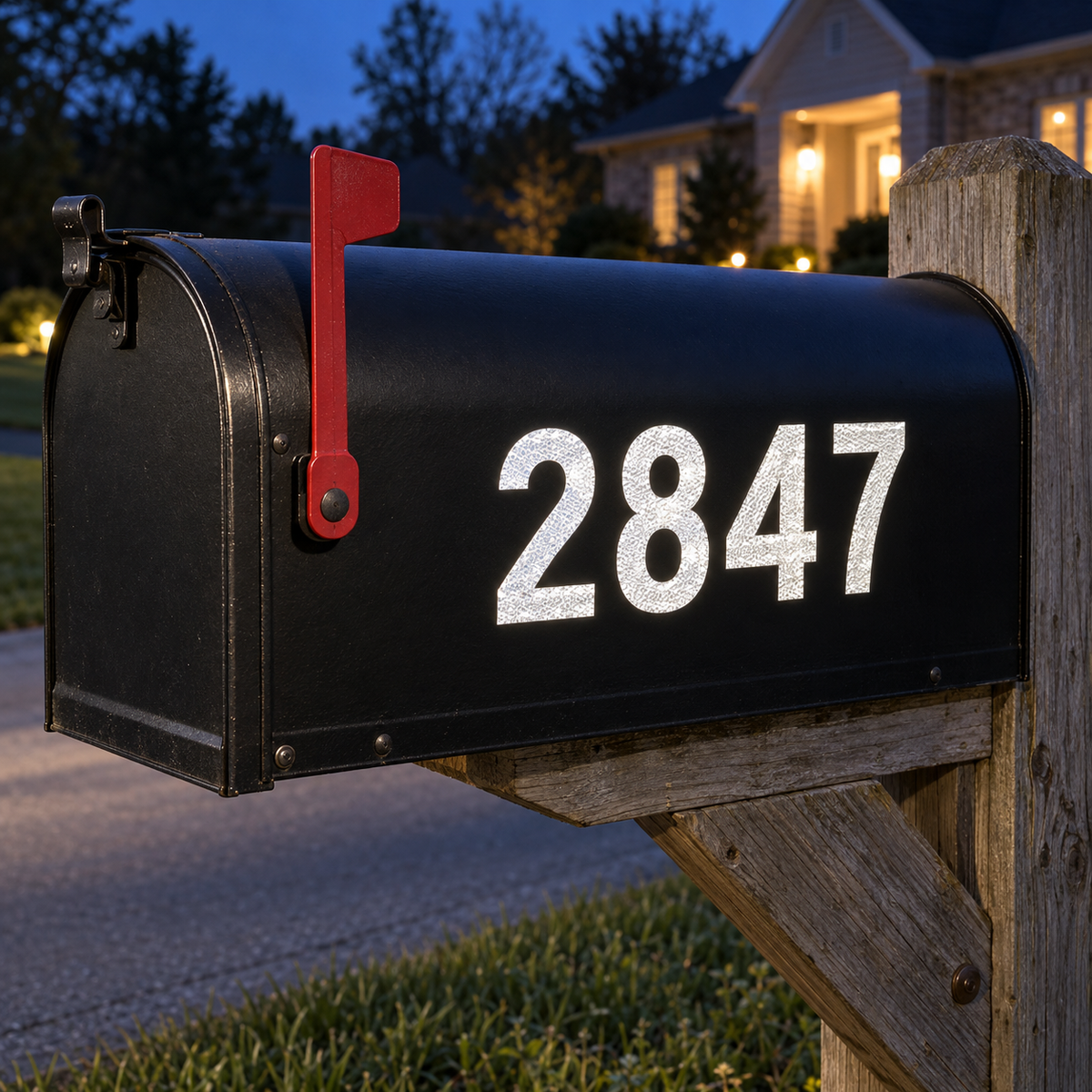
House numbers that disappear after dark are more than an inconvenience: delivery drivers miss the driveway, guests circle the block, and emergency responders lose valuable time. Reflective vinyl for mailbox numbers solves that by throwing light from headlights and flashlights straight back toward the viewer. In this guide, we explain how ORALITE 5300 reflective vinyl works, how to size reflective address numbers, and how to apply it to mailboxes, signs, and vehicles.
What Is ORALITE 5300?
ORALITE 5300 reflective vinyl is a commercial-grade reflective film made by ORAFOL. According to our product page, it is a 3.5 mil film with a permanent, clear solvent-based adhesive and a 7-year durability rating. It is designed for signs, reflective lettering and numbers, and decals on items like bikes, strollers, and scooters, and it suits short- to medium-term outdoor applications.
The product page also lists ORALITE 5300 as meeting MUTCD and ASTM D 4956 Type I Class 1. That said, it is intended for applications that do not require compliance with highway specifications, which we explain further below. If you want a starting point, white ORALITE 5300 reflective adhesive vinyl is the most versatile color for address numbers on dark mailboxes and posts.
How Retro-Reflection Works
Ordinary vinyl scatters light in every direction, so very little of a car's headlight beam comes back to the driver. Reflective film is built to be retro-reflective, which means it sends light back toward its source. Tiny optical elements in the film catch incoming light and redirect it back along nearly the same path it arrived on.
Because headlights sit close to the driver's eyes, a reflective number looks like it is glowing when a car turns into the street, while a plain vinyl number next to it barely shows up. In daylight, reflective film looks like a normal, slightly satin vinyl, so your mailbox does not look like a road sign during the day.
Keep in mind that reflection needs a light source. Reflective vinyl does not glow on its own in a dark yard. It shines when a headlight, flashlight, or porch light hits it.
Choosing Reflective Address Number Height
The most common mistake with mailbox and house numbers is making them too small. Readability depends on number height, stroke thickness, contrast, and viewing distance.
- Height. Many local codes based on the International Fire Code call for residential address numbers at least 4 inches tall, with larger minimums for commercial buildings or numbers set far from the road. Requirements vary, so treat this as a starting point, not a rule.
- Stroke width. Thin, decorative numerals lose legibility at distance. Choose a bold, simple font where the strokes are thick relative to the height.
- Contrast. White or yellow reflective numbers on a black or dark mailbox give the best contrast. Avoid pairing reflective white with a light-colored background.
- Placement. Put numbers on both sides of the mailbox so they are visible from either direction of travel.
Check your requirements. Address number rules come from your city or county, your fire marshal, your HOA, and for mailboxes, postal guidelines. Confirm the required height, color, and location before you cut.
Cutting Tips for Reflective Film
ORALITE 5300 is thicker than standard 651 vinyl, so treat it a little differently on your cutter:
- Run a test cut. Increase force as needed until the film cuts cleanly without scoring deeply into the backing.
- Use a fresh blade. A worn blade drags through thicker film and leaves ragged edges.
- Keep designs bold. Thick film does not weed tiny details well. Numbers, block letters, and simple shapes work best.
- Weed warm. Weeding at room temperature is easier than in a cold garage.
How to Apply Reflective Vinyl
- Clean the surface. Wash away dirt, then wipe with isopropyl alcohol. Painted metal mailboxes in particular collect oxidation and road film.
- Mask the design. Use a transfer tape strong enough to lift the thicker film from its liner. Our guide to using transfer tape with adhesive vinyl covers the full process.
- Position and hinge. Tape the design in place, check that it is level, and use the hinge method to apply one half at a time.
- Burnish firmly. Press from the center outward, paying special attention to edges and the small corners of each numeral.
- Peel slowly. Remove the transfer tape at a low angle. If a number lifts, lay it back down and burnish again.
Rounded mailbox tops are a curved surface, so apply numbers to the flat sides when possible. If you must go on a curve, our post on applying adhesive vinyl to curved surfaces without bubbles has helpful techniques. Apply in mild, dry weather and give the adhesive time to build its bond before it faces heavy rain or a pressure washer.
Great Uses for ORALITE 5300
- Mailboxes and posts. Reflective address numbers are the classic use and one of the most practical.
- Bikes, strollers, and scooters. Small reflective accents help others notice them in low light.
- Trailers and equipment. Business names, unit numbers, and outlines on utility trailers or equipment that is parked or moved after dark.
- Yard and property signs. Lettering for driveway markers, gate signs, and private-property signs.
- Vehicle decals. Phone numbers and logos on work trucks that get noticed at night.
How long any outdoor graphic lasts depends on sun exposure, climate, and cleaning. Our article on how long outdoor adhesive vinyl lasts and what affects it explains those factors.
Not a Replacement for Regulated Highway Sheeting
ORALITE 5300 is a great fit for personal, decorative, and commercial signage, but it is not intended to stand in for the regulated reflective sheeting that agencies specify for traffic control signs, highway signage, or vehicle conspicuity markings required by law. If a project must meet a specific government or agency requirement, use the material that the specifying authority calls for.
Reflective Options for Apparel
ORALITE 5300 is an adhesive vinyl, so it is meant for hard surfaces, not fabric. For jackets, running gear, and safety vests, use a reflective heat transfer vinyl instead. Our post on what reflective HTV is and where to use it covers the apparel side.
Frequently Asked Questions
What is the best reflective vinyl for mailbox numbers?
ORALITE 5300 is a commercial-grade reflective adhesive vinyl with a 7-year durability rating and a permanent adhesive, making it a strong choice for mailbox and address numbers.
How tall should reflective address numbers be?
Many codes call for residential numbers at least 4 inches tall, but requirements vary. Check with your local government, fire department, and HOA.
Does reflective vinyl glow in the dark?
No. Reflective vinyl bounces light back toward its source, such as headlights. Without a light shining on it, it looks like regular vinyl.
Can I use ORALITE 5300 on clothing?
No. It is an adhesive vinyl for hard surfaces. Use reflective HTV for apparel.
Light Up Your Address
A few bold numbers cut from reflective vinyl can make your home or business easier to find for drivers, visitors, and emergency crews. Shop ORALITE 5300 and transfer tape at Atlanta Vinyl and give your mailbox, trailer, or sign the nighttime visibility it deserves.