
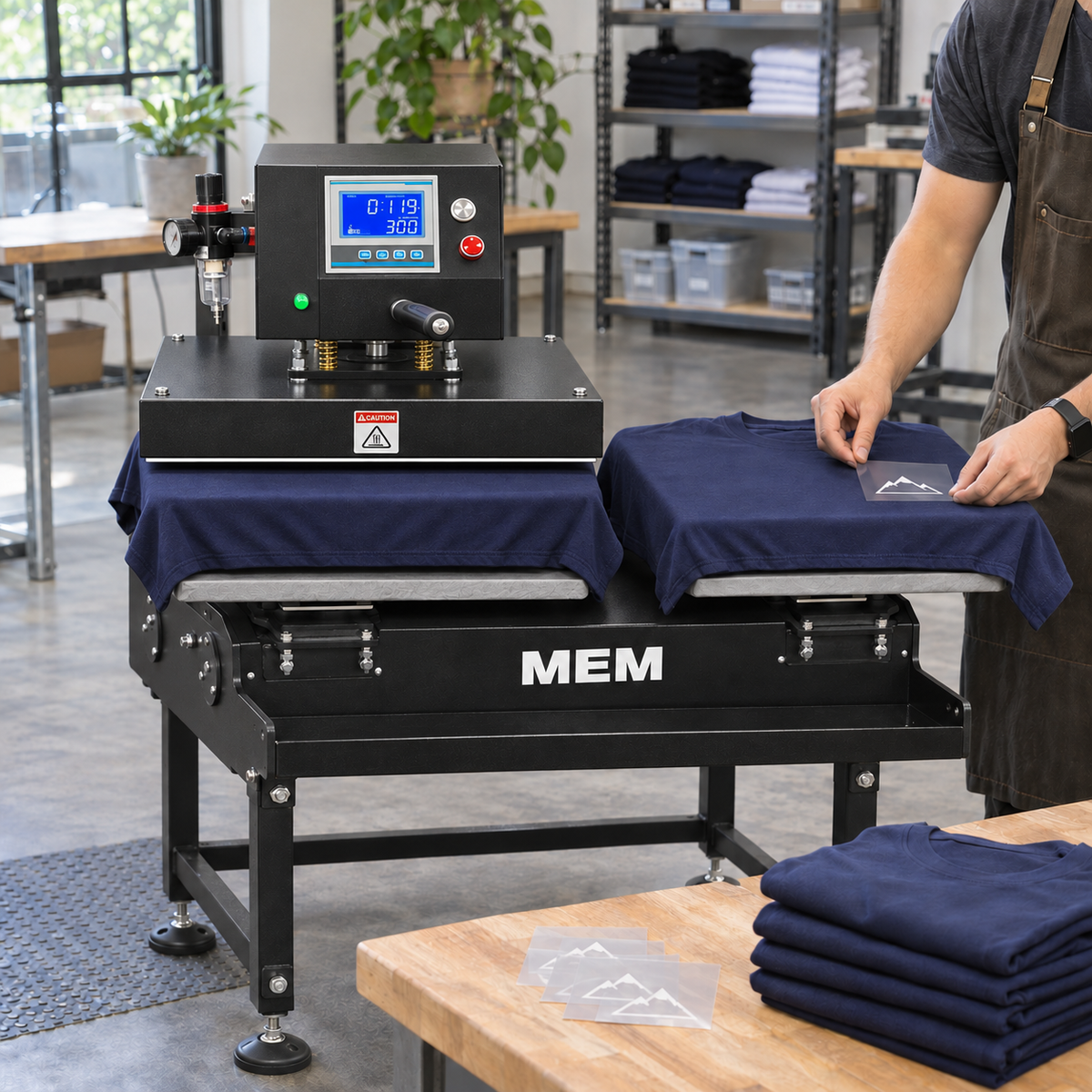
At some point every growing apparel business hits the same wall: the heat press becomes the bottleneck. Orders are coming in, transfers are ready, but you can only press one shirt at a time, and a lot of that time is spent loading, smoothing and unloading. A dual platen heat press, also called a double station press, is designed to solve exactly that problem. Here is how they work, what they cost and how to tell if one makes sense for your shop.
What Is a Dual Platen Heat Press?
A dual platen press has two lower platens and one heated upper platen (or, on some high-end models, two heads). The heat platen moves between the two stations. While one garment is pressing on the left, you are unloading and loading the right. When the timer ends, the press opens and moves to the other station. Instead of waiting for every press cycle, your hands stay busy the whole time.
How Much Faster Is a Double Station Press?
The press time itself does not change. A DTF transfer still needs its recommended time and a cold peel, and HTV still needs its dwell time. What changes is the idle time. On a single-station press, you load, press, wait, unload and repeat, and the press sits open while you prepare the next shirt. On a dual station, loading overlaps with pressing. For jobs with longer dwell times, such as DTF, sublimation or two-step applications, the gains are biggest because there is more press time to fill with loading.
The exact increase depends on your process, your transfer type and your operator, so track your shirts per hour before and after to see the real difference in your shop.
Types of Dual Platen Presses
Manual double station
Manual models use a handle to lock pressure, just like a standard clamshell or swing press, but give you two lower platens. They are the most affordable way into dual station production. Example: the TY-4050 16" x 20" manual double station heat press.
Auto open double station
Auto open presses release automatically when the timer ends, so the garment is not over-pressed if you are busy at the other station. Examples include the Vector 16" x 20" double station auto open press and the TITAN 16" x 20" auto open dual station press.
Pneumatic (air-powered) double station
Pneumatic presses use compressed air to close and apply pressure, which means consistent pressure on every press and far less operator fatigue. The TQA-4050 16" x 20" semi-automatic double station pneumatic press, for example, runs at up to 120 PSI on a 110V, 15A circuit and requires an air compressor (not included). At the top end, the Hotronix Dual Air Fusion ProPlace IQ offers two workstations that can operate in unison or independently, plus touch screen controls and ProPlace laser-guided placement.
Smart and touch screen models
Presses like the Hyper Stamp 16" x 20" double station press add smart touch screen controls for saving and recalling settings.
Browse all of our options in the dual platen heat press collection.
Benefits of a Dual Platen Press
- More output per hour without hiring another operator.
- Less wasted heat-up time, since the press is almost always working.
- Better consistency on pneumatic models, where pressure is the same every time.
- Two setups at once. You can load a different platen on each side, such as an adult platen and a youth or sleeve platen.
- Less operator fatigue on air-powered presses, which matters on long production days.
Things to Consider Before You Buy
- Space: double station presses are wider and heavier than single presses. Measure your work area and plan for a sturdy table or stand.
- Power: confirm the voltage and amperage. Many production presses need a dedicated circuit, and some are available in 240V versions.
- Air supply: pneumatic models need an air compressor, an air line and a place to keep it. Factor in noise and cost.
- Your workflow: to get the most from two stations, you need transfers ready, garments staged and a smooth loading routine.
- Volume: a dual platen makes the most sense when you regularly run batches of the same design, such as team, school, church and corporate orders.
When Is a Dual Platen Press Worth It?
A dual station press is usually a smart upgrade when:
- You regularly press orders of dozens of shirts at a time.
- Your single press is running most of the day and you are turning down or delaying work.
- You use longer press times, such as DTF, sublimation or two-step transfers.
- You want to grow output without adding another full-time operator.
If you mostly do one-off custom shirts, a quality single-station press may serve you better for now. Our guide to the best heat press machines for small businesses and why investing in a quality heat press pays off can help you decide.
Do the Math
A simple way to judge the investment: estimate how many extra shirts per week you could press, multiply by your profit per shirt, and compare that to the cost of the press. If your business owns its equipment, financing options can also help spread out the cost. Learn about financing your business growth with Atlanta Vinyl and Credit Key.
Tips for Running Two Stations Smoothly
- Stage everything first. Have garments sorted by size and transfers stacked in order.
- Use alignment aids like a laser alignment system to place transfers quickly and consistently.
- Protect both lower platens with Quick Slip lower platen protectors.
- Keep up with maintenance. Production presses work hard. Our guide to maintaining your heat press will help you avoid downtime.
- Know your pressure. Use our pressure settings guide to dial in each material.
Frequently Asked Questions
Is a dual platen press hard to learn?
Not at all. If you can use a standard press, you can use a dual station. The main adjustment is building a loading rhythm.
Can I use different platen sizes on each side?
On many models, yes. Check the manufacturer specifications for compatible interchangeable platens.
Do I need a compressor?
Only for pneumatic models. Manual and electric auto open double station presses do not need air.
A dual platen heat press does not make transfers bond faster, it makes your time more productive. For shops running regular batch orders, it is one of the most effective upgrades you can make. Have questions about which model fits your space and volume? Contact the Atlanta Vinyl team and we will help you compare.