
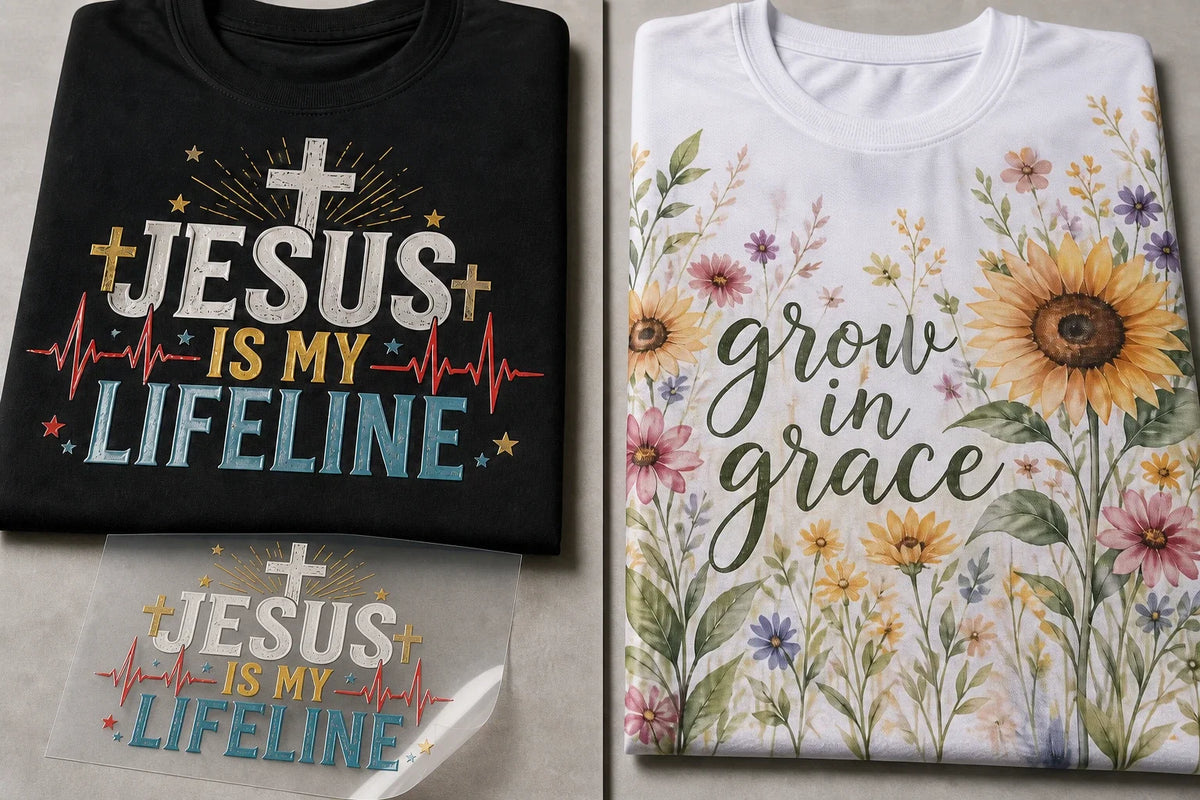
If you're deciding between DTF and sublimation, there's one fact that settles most of the argument before you get to anything else: sublimation only works on polyester, and only on light-colored polyester. DTF works on essentially any fabric in any color.
That single constraint eliminates sublimation for most apparel jobs. But when your job does fit inside it, sublimation produces something DTF genuinely cannot match. Here's the honest comparison.
How they actually work
Sublimation doesn't put ink on top of fabric. Under heat, the solid dye converts directly to a gas, penetrates the polyester fibers, and re-solidifies inside them. The fabric itself becomes the color. There is no layer sitting on the surface, which is why you can't feel a sublimated print at all — run your hand across it and you feel only fabric.
That's also why it only works on polyester. The dye needs polymer fibers to bond with. Cotton has nothing to hold it, so a sublimated print on cotton looks fine coming off the press and washes out within a cycle or two.
DTF prints your design onto a film with CMYK inks, then lays down a white underbase behind it and bonds it with adhesive powder. The white layer is the key: it makes the print opaque, so your colors stay true on a black shirt instead of going muddy. That layer is also why you can feel a DTF print — it sits on the fabric rather than in it.
Where each one wins
Choose sublimation when:
- The garment is white or light-colored polyester
- You want zero hand feel — performance wear, anything worn against skin
- You need edge-to-edge or all-over coverage
- Durability is critical; sublimation physically cannot peel or crack because there's no layer to separate
- You're decorating hard goods like mugs, tumblers or coated metal
Choose DTF when:
- The garment is cotton, a blend, or dark-colored
- You don't know what the fabric is, or you're printing on customer-supplied blanks
- You need one process to cover a mixed range of garments
- Your design needs to be genuinely opaque on a dark base
The trade-off nobody mentions
Sublimation on a poly/cotton blend produces a faded, washed-out result — and some people want that. A 65/35 blend gives you a soft vintage look that's popular in retail. But it's not consistent between blank suppliers, and it's not what a customer expecting vivid color will accept. If you're going to sell it, sell it deliberately as a vintage effect, and show a photo.
Cost
For most apparel runs these land close enough that cost shouldn't decide it. Our sublimation transfers start at $0.55 by size and $4.00 per 23" x 12" gang sheet; DTF gang sheets start at $6.00 per 22" x 12" sheet. The bigger cost lever in both cases is how efficiently you fill the sheet.
The short version
If the garment is light polyester and you want a print you can't feel, use sublimation. For anything else — dark garments, cotton, blends, or mixed jobs — use DTF. If you're still weighing it against other formats, our guide to choosing a transfer type walks through fabric, color count and quantity in order.
Shop custom DTF transfers · Shop custom sublimation transfers · See all custom heat transfers