
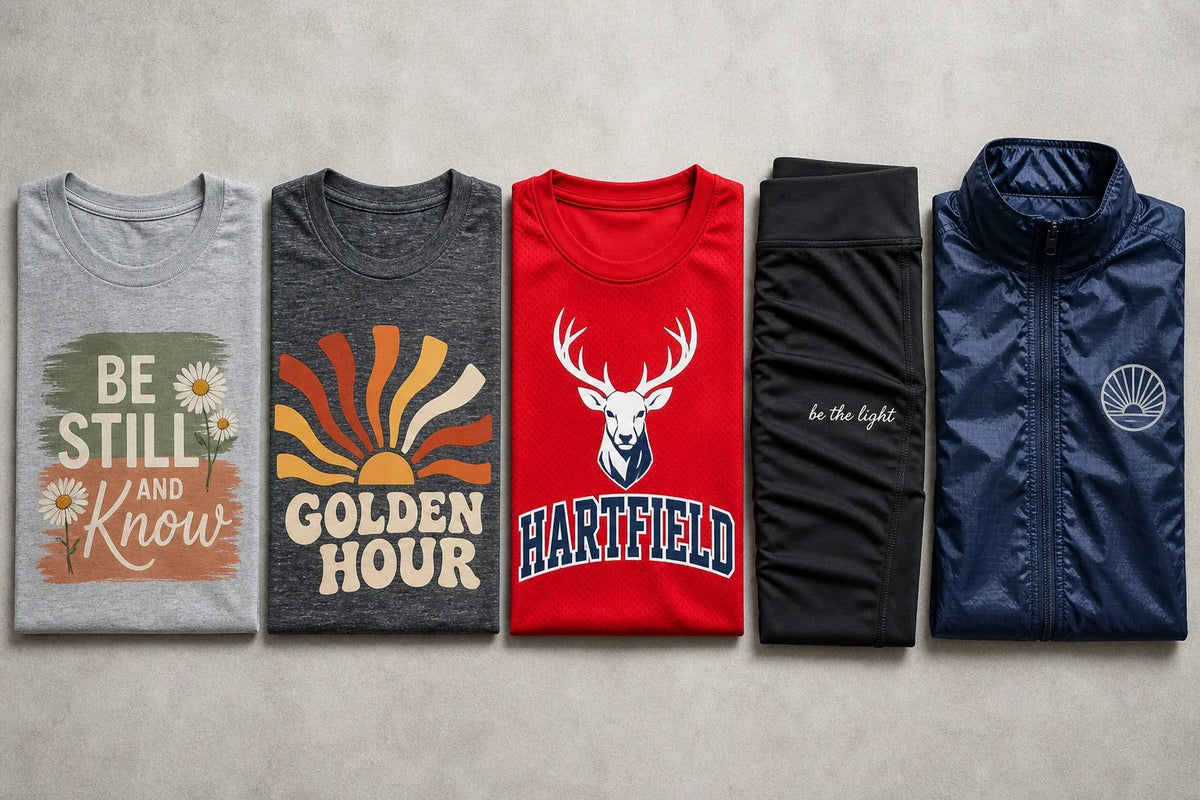
Nearly every ruined transfer job traces back to a fabric mismatch. Not bad technique, not a defective product — the wrong format on the wrong material. Here's what works where, and more usefully, what fails and why.
100% cotton
Use: almost anything. DTF for full color, Vintage screen print for a soft one-color print, Puff for dimension.
Cotton is the easy case. It tolerates high heat, holds ink well, and doesn't fight you. Pick your format based on the artwork rather than the fabric.
Don't use: sublimation. There's no polyester for the dye to bond with.
Cotton/poly blends
Use: DTF or Athletic screen print.
Blends mostly behave like cotton, with one important exception. On darker blends, the garment's own dye can migrate up into your print — usually turning white ink pink over the following hours or days. It typically isn't visible right off the press, which is exactly why people miss it during a test.
If you're testing a dark blend, check the piece 24 hours later, not 10 minutes later.
100% polyester
Use: Athletic screen print, DTF, or sublimation if the garment is white or very light.
Polyester causes more problems than any other common fabric, for two reasons. Dye migration is worse than on blends. And polyester scorches at temperatures cotton shrugs off — press too hot and you'll get a shiny, permanently flattened rectangle around your design.
Athletic screen print is our most opaque formula and is specifically built to block migration on poly.
Stretch fabrics — spandex, Lycra, elastane
Use: Performance screen print.
The failure here isn't peeling, it's cracking. Leggings and compression gear stretch and rebound thousands of times, and a rigid print fractures along the stress lines. Performance is formulated to flex and recover with the garment.
Don't use: rhinestones. Stones don't stretch. On a garment that does, they work loose at the flex points.
Heat-sensitive fabrics
Use: Silicone screen print.
Some garments can't survive a standard press cycle. Silicone applies at 280°F, low enough to be safe where 325°F would scorch or distort.
Nylon and coated fabrics
Use: test first. Genuinely.
Windbreakers, waterproof shells and coated bags are the hardest category. The same coating that repels water repels adhesive, and nylon melts at low temperatures. We won't promise a format works here sight unseen — order a small quantity and test before committing a run.
The rules worth memorizing
- Sublimation needs polyester. No exceptions.
- Dark polyester needs high opacity, or you'll get migration.
- Stretch fabric needs a stretch formula.
- Fiber content on the label doesn't tell you everything. Finish and mill vary. Test unfamiliar blanks.
For a full walkthrough that also covers color count and quantity, see which transfer type is right for your job, or browse all custom heat transfers.