
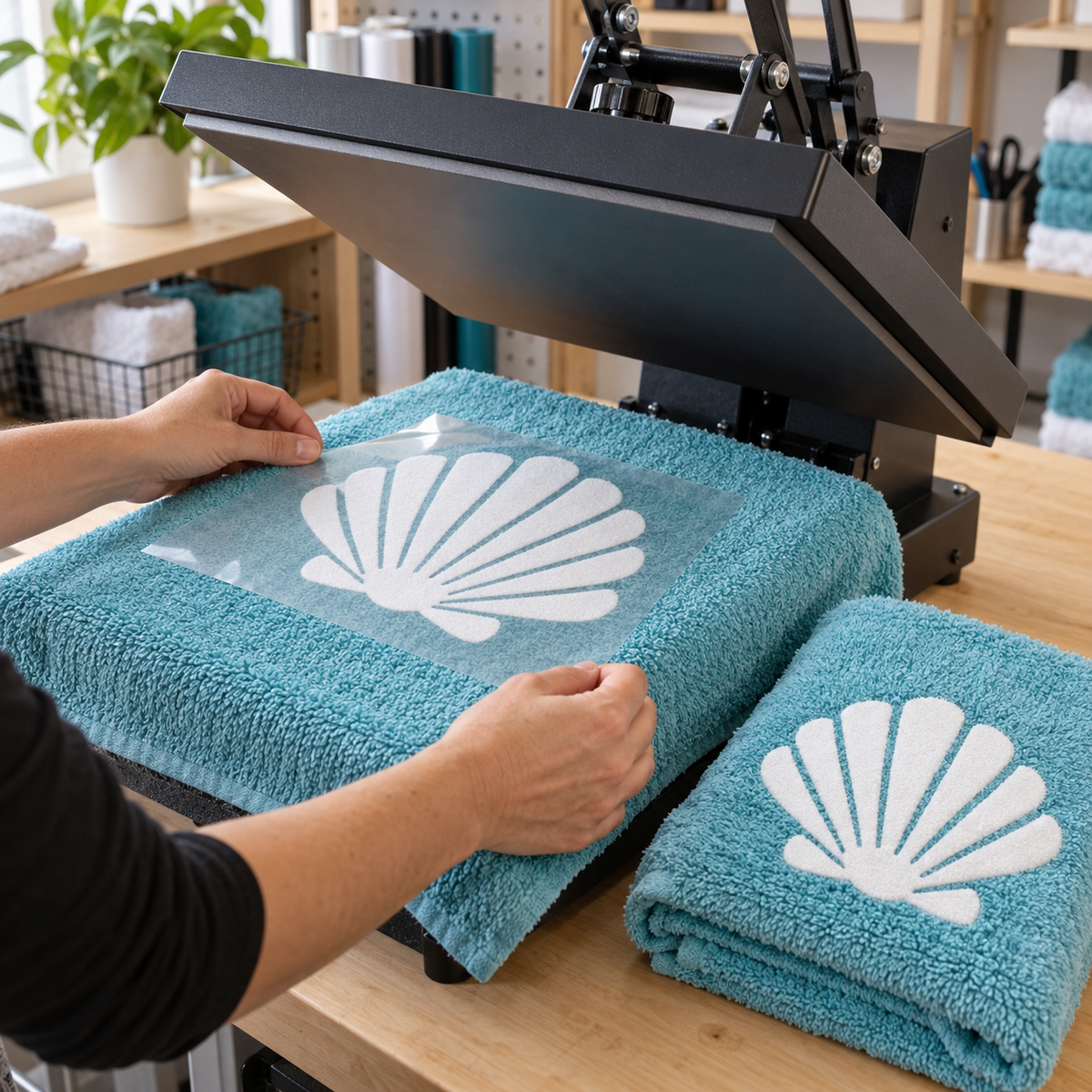
Why Towels Are Challenging for HTV
Custom towels and beach towels are popular items for wedding gifts, spa packages, personalized home goods, and resort merchandise. But terry cloth is one of the most challenging surfaces for heat transfer vinyl. The looped pile texture that makes towels so absorbent is the exact thing that makes HTV adhesion tricky. Here's everything you need to know to get great results on towels and terry cloth fabrics.
The Core Challenge: The Pile
Terry cloth is made of tiny looped fibers (the "pile") that stand up from the base fabric. When you press standard HTV on terry cloth, those loops can compress under heat and spring back once pressure is removed, taking the vinyl with them — or leaving gaps in the adhesion. The result is often a transfer that lifts, peels, or looks rough and uneven rather than smooth and clean.
The Best HTV Types for Terry Cloth and Towels
Not all HTV works equally well on towels. Here are the types that perform best:
- Siser StripFlock Pro: This is the top recommendation for terry cloth and towels. StripFlock has a flocked, velvety surface texture that is thick enough to bridge the gaps in the towel pile and adhere firmly to the base fabric rather than just the tips of the loops. The result is a design that looks intentional and textured, and bonds well to the terry cloth surface.
- Puff HTV: Puff vinyl's expanded, three-dimensional finish can accommodate the uneven surface of toweling better than flat vinyls. The puffed texture fills in around the loops and creates a design that looks great on towels.
- Thicker HTV films: Thicker HTV products in general tend to perform better on terry cloth than thin, flexible films. The extra material can bridge the texture better.
- Siser EasyWeed (with technique adjustments): Standard EasyWeed can work on towels if you use the right technique (covered below), but it requires more care than the options above.
What to Avoid on Terry Cloth
- Very thin or delicate HTV: Ultra-thin vinyls don't have enough body to bridge the towel pile effectively.
- Glitter HTV on high-pile towels: The textured surface of high-pile towels can prevent glitter HTV from bonding smoothly. Test first on a low-pile area.
- Small, intricate designs: Fine details and thin lines are very difficult to read on terry cloth texture. Stick to bold, simple designs with thick lines and large lettering.
The Compression Technique
One popular method for applying standard HTV to towels is the "compression" technique. Here's how it works:
- Pre-press the towel for 3-5 seconds to remove moisture and compress the pile slightly.
- Position your HTV transfer on the compressed area.
- Cover with a PTFE sheet or parchment paper.
- Press firmly for 10-15 seconds at standard HTV temperature (305-315 degrees F) — the same range used in our step-by-step guide to applying heat transfer vinyl.
- Allow to cool completely — do not peel hot or warm. Cool peel is essential on towels.
- For extra adhesion, re-press from the back of the towel for 5-8 seconds after the initial application.
Avoiding Common Mistakes
- Moisture is the enemy: Towels hold a lot of moisture. Always pre-press thoroughly to drive out all moisture before applying your transfer.
- Don't skip the cool peel: Peeling warm on terry cloth is one of the most common causes of transfer failure. Let the design cool completely.
- Use firm pressure: Terry cloth requires more pressure than smooth fabrics. Make sure your heat press is set to firm pressure.
- Test before production: Always do a test press on a scrap towel or an inconspicuous area before committing to a full production run.
Wash and Care for Customized Towels
To maximize the lifespan of HTV on towels:
- Wash in cold water on a gentle cycle
- Tumble dry on low heat or hang dry
- Do not use fabric softener (it can affect adhesion over time)
- Do not iron over the design
Shop HTV for Towels at Atlanta Vinyl
Atlanta Vinyl carries Siser StripFlock Pro, Puff HTV, and other specialty vinyls that work beautifully on towels and terry cloth. Browse our full HTV collection to find the right product for your next towel customization project. For more non-apparel projects, see our guide to decorating bags, totes, and accessories with HTV and DTF.