
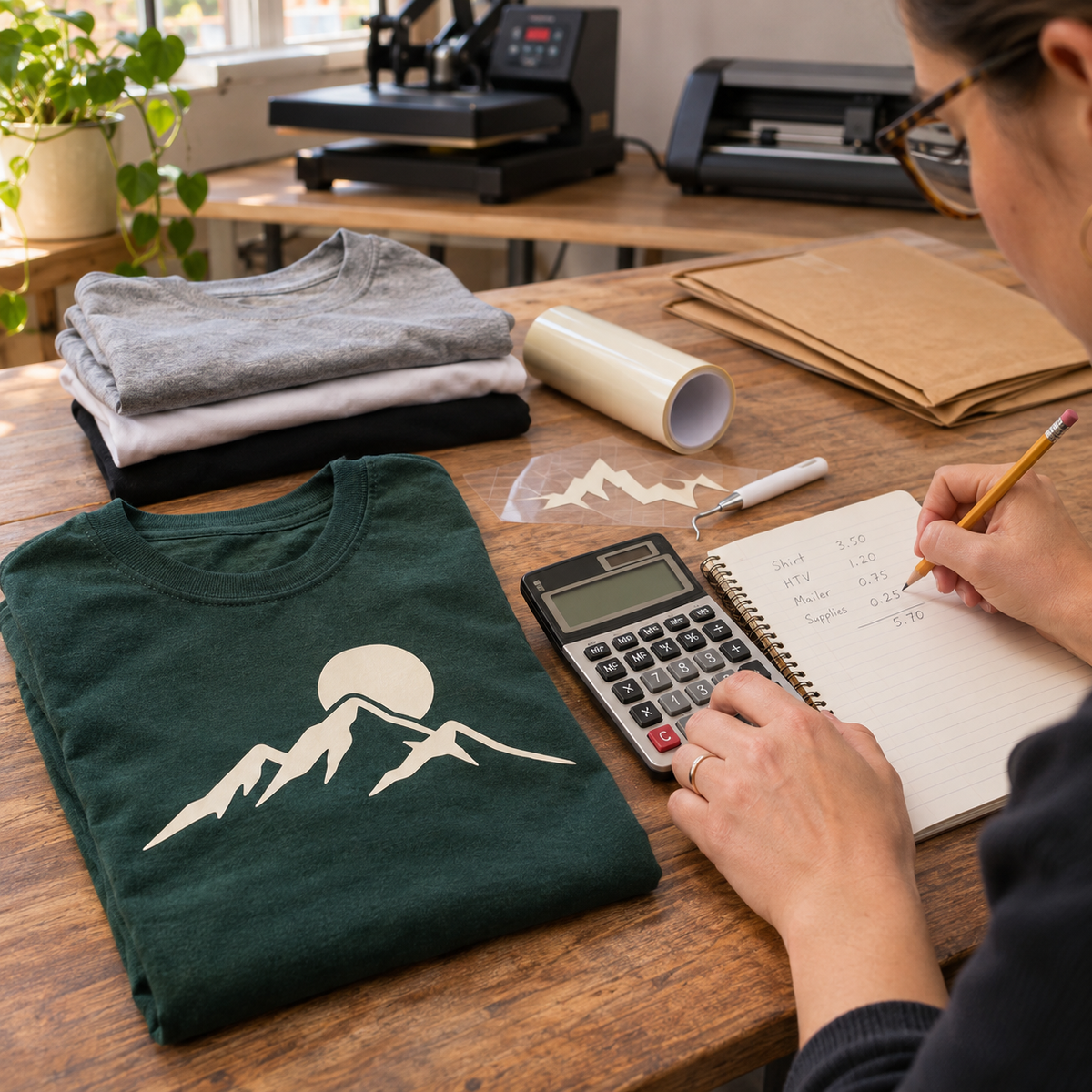
You can press a beautiful heat transfer vinyl shirt and still lose money on it. Many new decorators price by guessing or by matching the cheapest seller online, then realize months later that they have been working for free. The fix is simple: know your real cost per shirt, then price on purpose. This guide walks you through a straightforward formula for pricing HTV shirts that covers your materials, your time and your business, with profit left over.
The Basic Pricing Formula
Price = (Materials + Labor + Overhead) ÷ (1 – Desired Profit Margin)
Let's break down each piece.
Step 1: Calculate Your Materials
The blank shirt
Your shirt cost depends on brand, style, size and color. For example, a Gildan 5000 heavy cotton tee is a budget-friendly classic, while a Bella Canvas unisex jersey tee or Comfort Colors shirt costs more but feels more premium. Remember that larger sizes like 2XL and up usually cost more. Browse options in our blank apparel collection.
Vinyl cost per square inch
The most accurate way to price vinyl is by the square inch.
- Take the price of the roll.
- Divide by the roll's total square inches (width × length in inches).
Example: A 12" x 5 yard roll of Siser EasyWeed is listed at $39.99. Five yards is 180 inches, so the roll has 12 × 180 = 2,160 square inches. $39.99 ÷ 2,160 = about $0.019 per square inch. A 12" x 50 yard roll at $310.99 works out to about $0.014 per square inch, which shows how much bulk rolls can save. Learn more in why buying HTV in bulk is a good option.
Next, measure the rectangle your design actually uses on the roll, not just the printed area, and add 10 to 20 percent for test cuts, mistakes and scrap. A 10" x 10" design is 100 square inches; with waste, call it 120. At $0.019 per square inch, that is about $2.22 in vinyl.
Other materials
Add small costs like cover sheets, packaging, care cards and labels. They add up across hundreds of orders.
Step 2: Price Your Labor
This is the step most crafters skip. Time how long a shirt takes from start to finish: designing, cutting, weeding, pressing, packing and talking with the customer. Then decide on an hourly rate you want to earn.
Example: If a one-color shirt takes 15 minutes and you value your time at $20 per hour, labor is $5.00.
Weeding is often the biggest time cost. Simple bold designs weed in seconds; detailed script and distressed designs can take much longer. Price complex designs accordingly. Our tips for weeding HTV like a pro can help you speed up.
Step 3: Add Overhead
Overhead covers the costs of running your business that are not tied to one shirt: your heat press and cutter, blades, electricity, software subscriptions, website fees, payment processing, marketing and rent. A simple method is to estimate your monthly overhead and divide it by how many shirts you make per month.
Example: If overhead adds about $1.00 per shirt, include it.
Step 4: Set Your Profit Margin
Using the examples above:
- Blank: $3.62
- Vinyl: $2.22
- Labor: $5.00
- Overhead: $1.00
- Total cost: about $11.84
At a 40% profit margin: $11.84 ÷ 0.60 = about $19.74. At a 50% margin: $11.84 ÷ 0.50 = about $23.68.
These are example numbers only. Your costs, labor rate and local market will be different, so plug in your own figures.
Pricing Multi-Color and Specialty HTV
- Each extra color adds vinyl, weeding time and pressing time. Many shops add a set amount per additional color or layer.
- Specialty vinyl like glitter, metallic, holographic, puff and reflective costs more per roll, and some is harder to weed. Calculate those materials separately.
- Extra locations such as back prints, sleeves and names add time and material. Price each placement.
- Names and numbers on team orders should be priced per name or per number.
Pricing Bulk Orders
Bulk orders let you cut and weed multiple designs at once, buy vinyl in larger rolls and set up the press once. That lowers your cost per shirt, so you can offer tiered pricing like 12+, 24+ and 48+ pieces while protecting your margin. For large, multi-color runs, compare your HTV cost to custom DTF transfers, which can be cheaper per shirt once you factor in weeding time. Our article on pricing custom DTF orders for profit covers that side.
Common Pricing Mistakes
- Not paying yourself. If labor is not in the price, you are giving it away.
- Forgetting waste. Misprints, test cuts and scraps are real costs.
- Matching mass-market prices. You are offering custom, local, personal work. Price for that value.
- Ignoring size upcharges. Add a fee for 2XL and above.
- Never raising prices. Review your costs regularly as blank and shipping prices change.
Ways to Increase Profit Without Raising Prices
- Buy your most-used colors in bulk rolls, like our wholesale EasyWeed rolls.
- Nest designs tightly to reduce waste. See getting the most use out of your HTV.
- Offer add-ons like back prints, sleeve prints and matching accessories.
- Create a menu of ready-made designs that are faster to produce.
- If you qualify, review our tax exemption policy for resale purchases.
Frequently Asked Questions
What profit margin should I aim for?
It depends on your market and business model, but many decorators target a margin that covers growth, slow months and equipment replacement. Use the formula and adjust until the price works for both you and your customers.
Should I charge a setup fee?
Many shops charge a design or setup fee for custom artwork, especially on small orders. It covers your design time.
Is HTV or DTF more profitable?
HTV is usually more profitable for simple one- or two-color designs. DTF often wins for full-color art and large, complex orders. Compare them in DTF printing vs. HTV.
Profitable pricing is not about charging the most, it is about knowing your numbers. Add up your blank, vinyl, labor and overhead, choose a margin and stick to it. For more help growing your shop, read how to start a t-shirt business and how to gain more customers.