
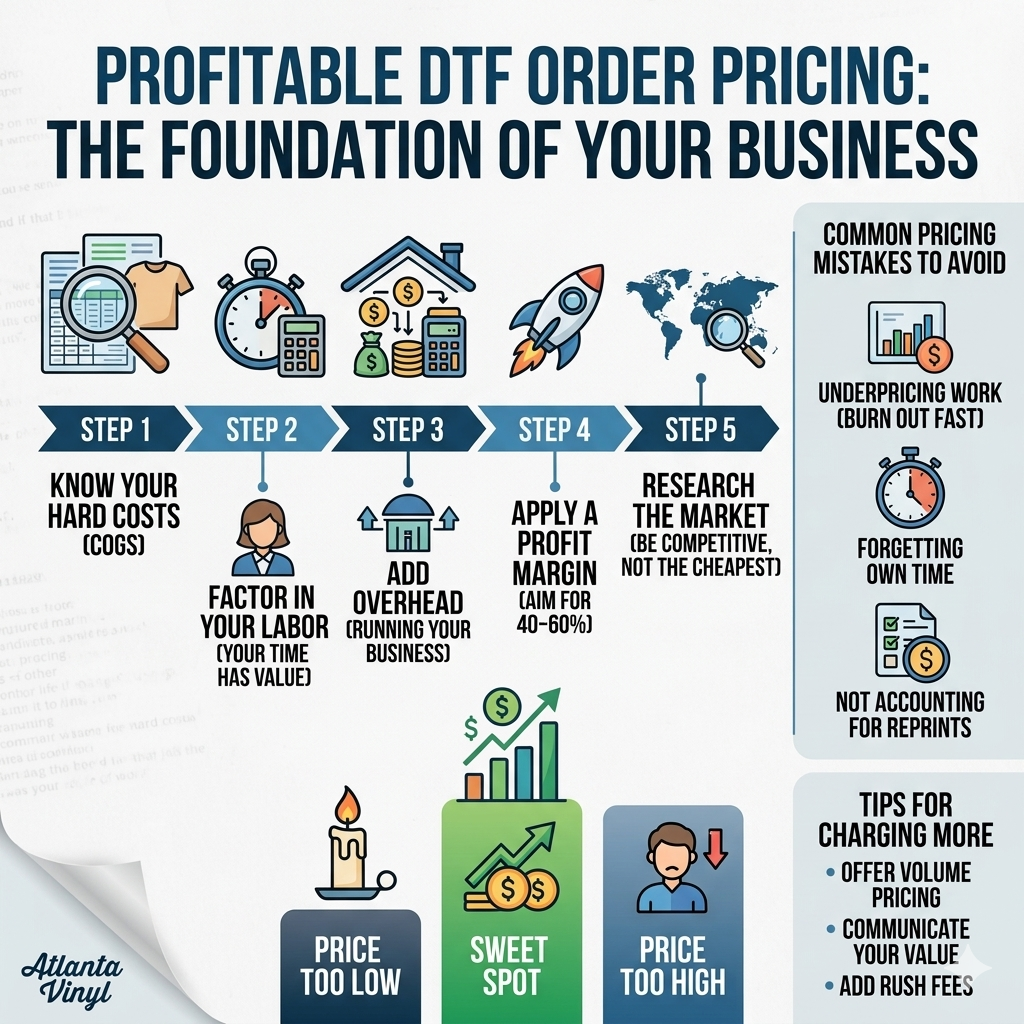
Why Pricing Your DTF Orders Correctly Is the Foundation of a Profitable Business
One of the most common mistakes new custom apparel sellers make is underpricing their work. Whether you're running a home-based DTF business or growing into a full-scale production shop, knowing how to price your custom DTF transfer orders accurately is what separates a hobby from a real business. Price too low and you'll burn out fast. Price too high without justification and you'll lose customers. The goal is to find the sweet spot that covers your costs, rewards your time, and leaves room for growth.
Step 1: Know Your Hard Costs
Before you charge a single customer, you need to know exactly what it costs you to produce an order. For DTF transfers, your hard costs typically include:
- Transfer cost: What you pay per transfer or per DTF gang sheet from your supplier (like Atlanta Vinyl). Factor in the size of the design and any quantity discounts you're getting.
- Blank garment cost: The price of the blank apparel — shirt, hoodie, tote bag, or other item — you're pressing onto. Don't forget shipping costs on your blanks.
- Pressing consumables: Heat press electricity usage, parchment paper or Teflon sheets, and any pressing accessories.
- Packaging: Poly bags, tissue paper, custom tags, or boxes if you're shipping to customers.
- Shipping: If you're shipping finished goods, calculate your average shipping cost per order.
Add all of these together to arrive at your Cost of Goods Sold (COGS) for each item.
Step 2: Factor in Your Labor
Your time has value. Even if you're just starting out and working from home, you should account for the time it takes to receive an order, prep the file, press the transfer, package the item, and handle customer communication. A common approach is to decide on an hourly rate you'd like to earn — say $20–$25/hour — and estimate how many finished items you can produce per hour. Divide your hourly rate by that number to get a per-item labor cost.
For example, if you can press 12 shirts per hour and want to earn $24/hour, your labor cost is $2 per shirt.
Step 3: Add Overhead
Overhead includes all the costs of running your business that aren't directly tied to a single order. Think about your heat press payment plan or depreciation, your Shopify store fees, advertising costs, software subscriptions, and workspace costs. Divide your total monthly overhead by the number of items you sell per month to get an overhead cost per item.
Step 4: Apply a Profit Margin
Once you have your COGS, labor, and overhead totaled, that's your break-even price. From there, apply a profit margin. For custom apparel, a gross margin of 40–60% is a common target. To calculate your selling price from a target margin, use this formula:
Selling Price = Total Cost ÷ (1 – Desired Margin)
So if your total cost per shirt is $12 and you want a 50% margin: $12 ÷ 0.50 = $24 selling price.
Step 5: Research the Market
Pricing doesn't happen in a vacuum. Check what competitors on Etsy, local markets, and social media are charging for similar custom apparel. You don't need to be the cheapest — you need to be competitive for the quality and service you offer. If your prices are higher, make sure your branding, quality, and customer experience justify it. Our guide to building a custom apparel menu and price list can help you structure your offer.
Tips for Charging More Without Losing Customers
- Offer volume pricing: Discounts for orders of 6, 12, or 24+ pieces encourage larger orders and improve your efficiency.
- Communicate your value: Highlight turnaround times, quality of materials, and your satisfaction guarantee.
- Add rush fees: Charge a premium for orders needed in under 48–72 hours — a rush DTF printing service makes those fast turnarounds possible.
- Bundle services: Offer full-service packages that include design, printing, and packaging for a higher overall ticket.
Common Pricing Mistakes to Avoid
Many new sellers forget to price in their own time, don't account for reprints or mistakes, and undercharge for small orders that actually cost more per unit to fulfill. Always build a small buffer (5–10%) into your pricing to cover the occasional mispress or customer issue.
Pricing your custom DTF transfer orders correctly takes a little math upfront, but it pays off in the long run. When your numbers are solid, you can grow with confidence — taking on more orders, investing in better equipment, and building a sustainable business. Atlanta Vinyl is here to help you keep your transfer costs competitive so your margins stay healthy.