
DTF vs. Screen Print Transfers
Two ways to get professional prints without running screens yourself. Here's exactly when to choose spot-color screen print transfers and when full-color DTF is the better tool — and why we make both.
The short answer
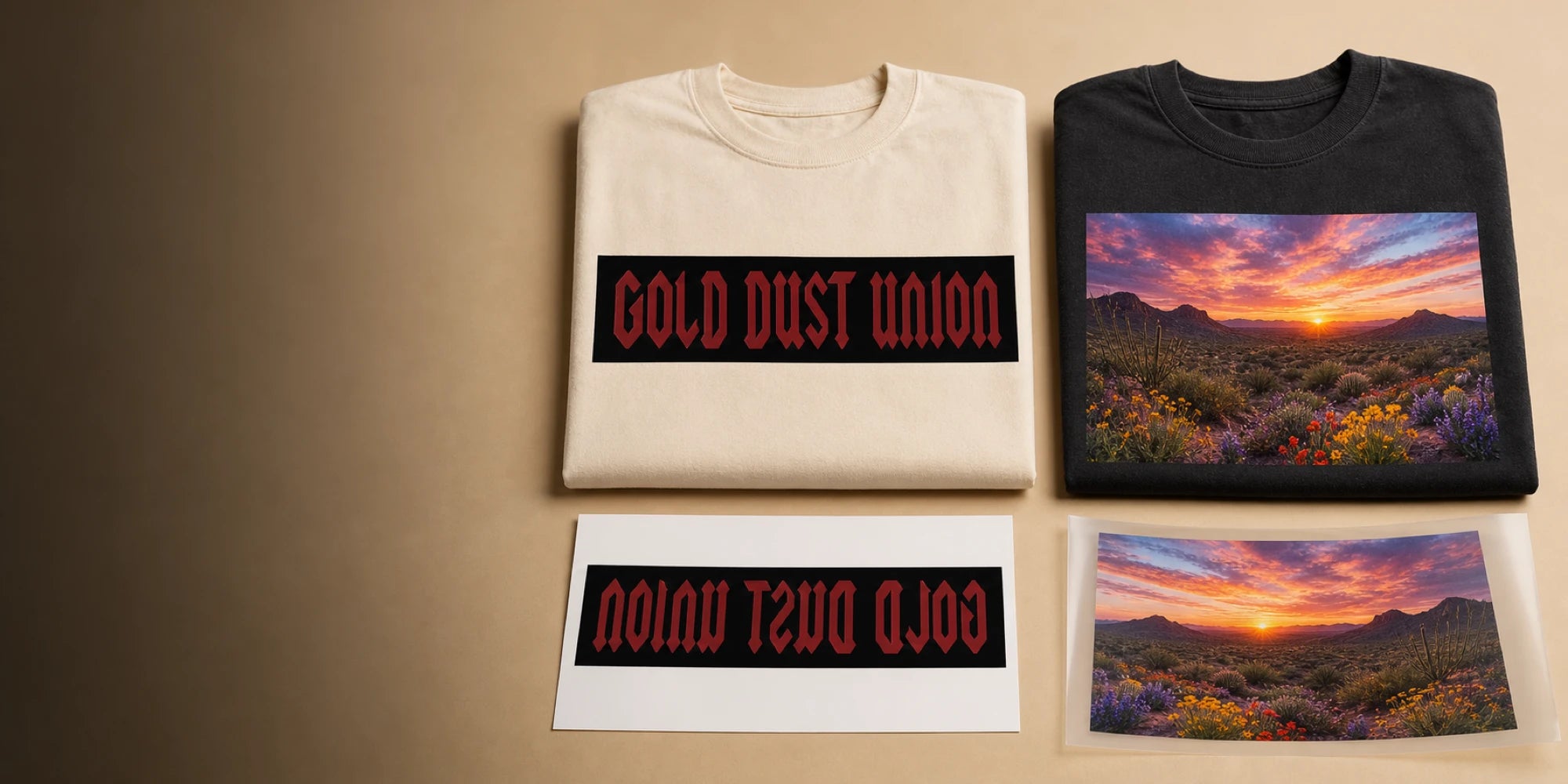
Screen print transfers and DTF (direct-to-film) transfers both ship to you ready to heat-press — no screens, no curing, no mess on your end. The difference is how the design is made and what it's best at. Screen print transfers are spot-color: each ink is printed as a solid, opaque layer, giving you bold, durable prints with a soft hand at a low per-piece cost — ideal for logos, names, numbers, and simple 1–3 color designs. DTF transfers are digitally printed in full color onto film, so they reproduce photographs, gradients, and unlimited colors with no setup — ideal for detailed art and small, on-demand runs on virtually any fabric or color.
For most shops the choice comes down to three things: how many colors your design has, how many pieces you're ordering, and the fabric. Simple, bold artwork in 1–3 colors, ordered in volume, is where screen print transfers shine and cost the least per print. Photographic or many-color art, or short runs where you'd rather not think about color counts, is where DTF wins.
You don't have to pick a side for your whole business. Plenty of decorators run both — DTF for one-offs, complex designs, and rush jobs; screen print transfers for planned production of simple artwork. Atlanta Vinyl makes both, so you can match the method to each job. Below is a straight comparison and a quick decision guide.
Side-by-Side Comparison
| Screen Print Transfers | DTF Transfers | |
|---|---|---|
| Best for | Bold 1–3 color designs on Athletic; single color on our other formulas | Full-color, photographic, or highly detailed art |
| Colors | 1–3 solid spot colors (Athletic); 1 color on other formulas | Unlimited / full color |
| Fabrics | Cotton, polyester & blends (formula-dependent) | Virtually any fabric, including darks & textured |
| Minimum order | As low as 8 sheets | No minimum — order a single sheet |
| Setup / screen fees | None on ready-to-press gang sheets | None |
| Hand feel | Soft to bold by formula (Vintage is ultra-soft) | Smooth, thin, slight film |
| Opacity on darks | High — opaque inks, usually no underbase | High — printed with a white underbase |
| Durability | Excellent; bonds in, ages by softening | Excellent; flexible, ages by gradual fade |
| Cost at low quantity | Higher per piece | Lower per piece |
| Cost at high volume | Lowest per piece | Stays about the same |
| Turnaround | Ships as fast as 1–3 business days | Ships in as fast as 24 hours |
Which Should You Choose?
Choose Screen Print Transfers if…
- Your design is 1–3 solid colors (logos, names, numbers, team wear)
- You want the lowest cost per print at volume
- You want an ultra-soft hand (Vintage) or maximum opacity and durability (Athletic)
- You're pressing cotton, polyester, or blends
Choose DTF Transfers if…
- Your design is photographic, gradient, or many colors
- You need small quantities or one-offs with no color limits
- You're printing on tricky fabrics or lots of different garment colors
- You want to press many different designs without per-color setup
The honest bottom line
Most shops use both, and that's the smart play: DTF for small runs, samples, complex designs, and rush jobs; screen print transfers for planned production of bold, simple artwork where they cost the least and feel the best. Still unsure? Order a sample and press it yourself, or send us your art and we'll tell you which will look and last better for that specific design.
DTF vs Screen Print Transfers FAQ
Which lasts longer, screen print transfers or DTF?
Which is cheaper?
Which feels softer?
Can I use DTF on dark shirts?
Do screen print transfers crack?
Which should I choose for a photo or full-color logo?
Ready to order?
Screen Print Transfers for bold 1–3 color designs at the lowest cost, or Custom DTF for full-color art on any fabric.