
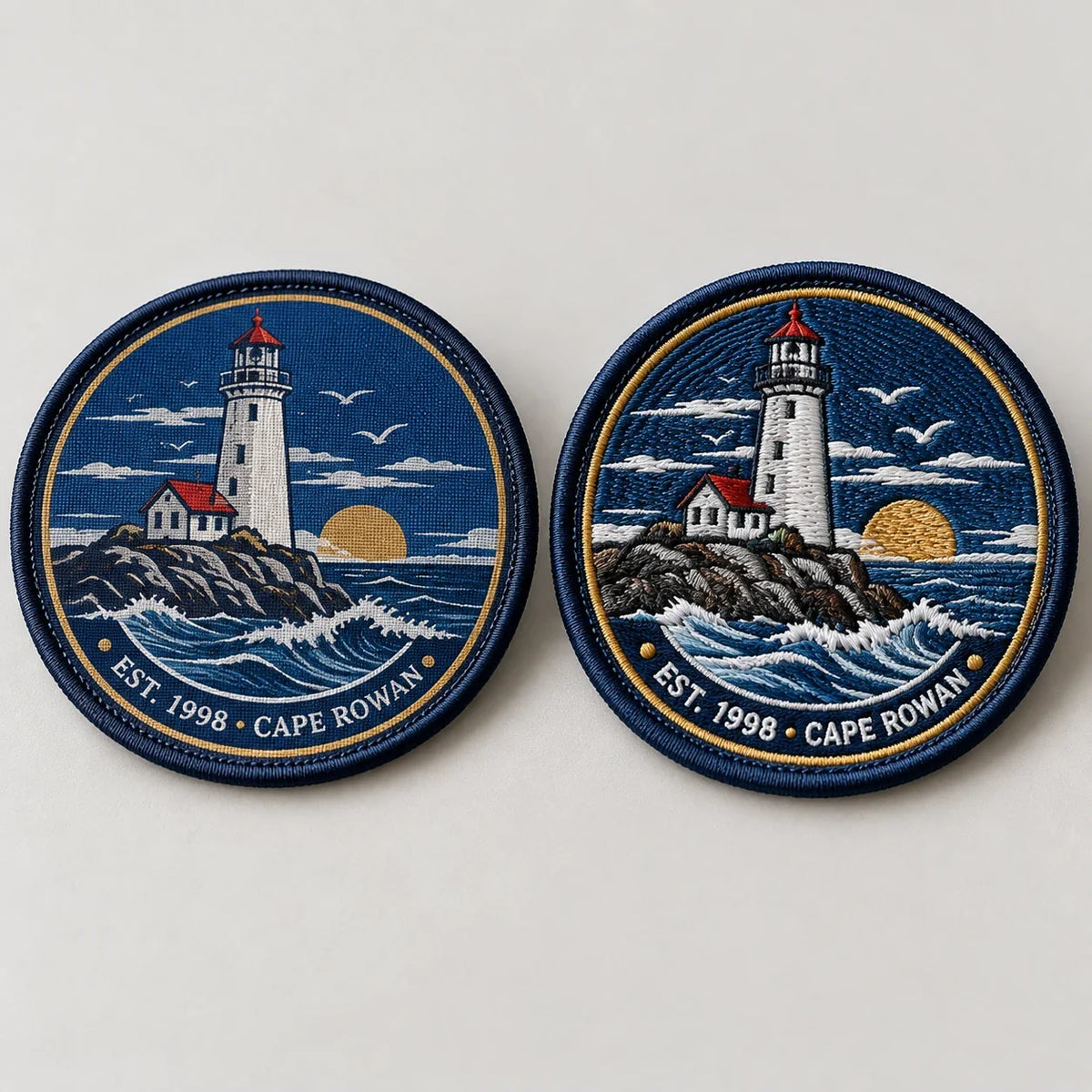
Most people arrive at custom patches knowing they want a patch and not much else. Then they hit three words, embroidered, woven and PVC, and the differences are never explained anywhere useful. Here is the honest version, including what each one is bad at.
Short answer: embroidered is the classic stitched patch and the safest default. Woven is flat and holds finer detail than embroidery can. PVC is molded rubber, fully waterproof, and will never fray. Everything below is the detail behind that.
The one-minute comparison
| Embroidered | Woven | PVC | |
|---|---|---|---|
| What it is | Polyester thread stitched onto a twill base | Fine thread woven on a loom into the fabric itself | Soft rubber molded in a die, one layer per color |
| Texture | Raised, you can feel the stitches | Flat and thin, almost like a printed label | Smooth rubber with sharp raised dividers between colors |
| Smallest readable text | About 1/4 inch tall | About 1/8 inch tall | About 1/4 inch tall |
| Colors | Up to 9 included | Up to 9 included | Up to 9 included |
| Max size | 14 inches | 7 inches | 4 inches |
| Waterproof | No, thread absorbs water | No | Yes, completely |
| Will it fray | Possible at the edge over years | Possible at the edge over years | Never, the edge is sealed in the mold |
| 3 inch at 50 pieces | $5.00 each | $4.00 each | $7.75 each |
| 3 inch at 500 pieces | $1.50 each | $1.75 each | $2.75 each |
Embroidered patches: the default for a reason
An embroidered patch is stitched in polyester thread on a twill backing, finished with either a rolled merrow border or a heat-sealed hot-cut edge. It is the patch most people picture, and it is the right answer more often than not.
It has real texture. Light catches the satin stitching, the patch sits proud of the garment, and it reads as something made rather than printed. It also scales bigger than anything else we carry, up to 14 inches, which is what you need for a jacket back patch.
Where it struggles is fine detail. Every element has to be big enough for a needle to render it. Text under about a quarter inch tall starts to close up, hairline rules disappear, and a photographic gradient has to be redrawn as flat blocks of thread color. If your logo is a detailed crest with small type around the rim, embroidery will simplify it whether you want that or not.

Choose embroidered when
- You want the classic, textured patch look
- The patch is going on a uniform, a club vest or a letterman jacket
- You need a size above 7 inches
- Your artwork is bold, with few small elements
Woven patches: when the detail matters
A woven patch is not stitched onto a base. The design is the fabric, woven on a loom from much finer thread than an embroidery machine uses. The result is thin, flat and flexible, with a surface closer to a clothing label than a traditional patch.
That finer thread is the whole point. Woven holds text at roughly half the size embroidery needs, keeps thin lines thin, and reproduces a complicated mark without redrawing it. If you have ever had an embroidered sample come back and thought the logo looked heavier than your artwork, woven is the fix.
The trade is texture and scale. A woven patch is subtle. There is no relief to catch the light, and some people find it reads as less premium next to embroidery for exactly that reason. It also tops out at 7 inches.

Choose woven when
- Your logo has small text, thin lines or fine detail
- You want a flat, low-profile patch
- You are making something label-like for apparel
- You want the lowest cost per piece at mid volumes
PVC patches: built for weather and abuse
PVC patches are molded, not stitched or printed. Your artwork is cut into a metal mold with a recess for each color, soft PVC rubber is laid into each recess, then heat and pressure cure the whole thing into a single flexible piece with a sealed edge.
Nothing else we carry is waterproof. Thread absorbs water; rubber does not. A PVC patch on a pack, a jacket or a plate carrier will look the same after a season outdoors as it did the day it arrived. There are no threads, so there is nothing to fray, unravel or pill. You can also mold it to any outline, and 3D PVC builds the design in sculpted layers with real depth.

The costs are size and price. Four inches is the largest PVC mold, and that is a hard ceiling rather than a pricing decision. PVC also runs the most expensive of the three at every quantity, because the mold work is real.
Choose PVC when
- The patch will live outdoors or get wet
- It is going on gear, a pack or tactical kit
- You want a die-cut shape with a clean sealed edge
- You want depth, which is what 3D PVC is for
A note on price. Every number in this article is a real published price from our own calculators, not a range. Most patch companies make you request a quote before they will tell you anything. You can see the full table for any type, at any size and quantity, on its product page.
So which one?
Run through it in this order.
- Is it going to get wet or live outside? PVC. Nothing else is waterproof.
- Does the artwork have small text or fine lines? Woven. It is the only one that holds them.
- Is it bigger than 7 inches? Embroidered. Nothing else goes that large.
- None of the above? Embroidered. It is the classic look, it is mid-priced, and it is what most people picture when they say patch.
Still not sure? Send your artwork with your order and we will tell you honestly if the type you picked is going to fight your design. Nothing goes into production until you approve a free mockup, so there is no risk in starting.
What about the other three?
We carry six types. The three above cover most orders, but for completeness: chenille is the plush varsity letter look, leather is a tonal debossed or laser-engraved mark for hats and workwear, and sublimated prints full color, which is the only way to put a photograph on a patch.
See all six types side by side
Real prices, minimums and max sizes for every patch we carry, on one page.
Compare custom patches