
In the vast landscape of custom apparel decoration, few methods offer the "wow" factor quite like sublimation. If you’ve ever seen a t-shirt with a photorealistic image that feels completely soft to the touch—as if the design is part of the fabric itself—you’ve likely admired sublimation.
However, unlike other methods such as DTF prints or standard vinyl, sublimation has a very specific set of rules. It is not a "stick it on anything" solution. It requires a specific chemical reaction to work, and if you don't know the parameters, you might end up with a faded, ghostly image or a ruined shirt.
At Atlanta Vinyl, we want your projects to succeed on the first press. Whether you are a seasoned shop owner or a crafter looking to expand your offerings, this guide covers everything you need to know before you hit "order" on your first batch of custom sublimation transfers.
The Magic of Sublimation: How It Works
To understand the requirements, you have to understand the science. "Sublimation" is the chemical process where a solid turns directly into a gas without becoming a liquid first.
When you order a custom sublimation transfer from ATL Vinyl, you receive a sheet of paper with special solid ink printed on it. When you apply heat (usually around 400°F) and pressure, that ink turns into a gas. Simultaneously, the pores of the polyester fabric open up. The gas permeates the fabric fibers, and when it cools, the pores close, trapping the ink inside.
This means the ink doesn't sit on the fabric like a sticker; it becomes part of the fabric. This results in a print with "zero hand feel"—you can't feel the design at all—and incredible durability. It won't crack, peel, or wash out.
The Golden Rule: Material Matters
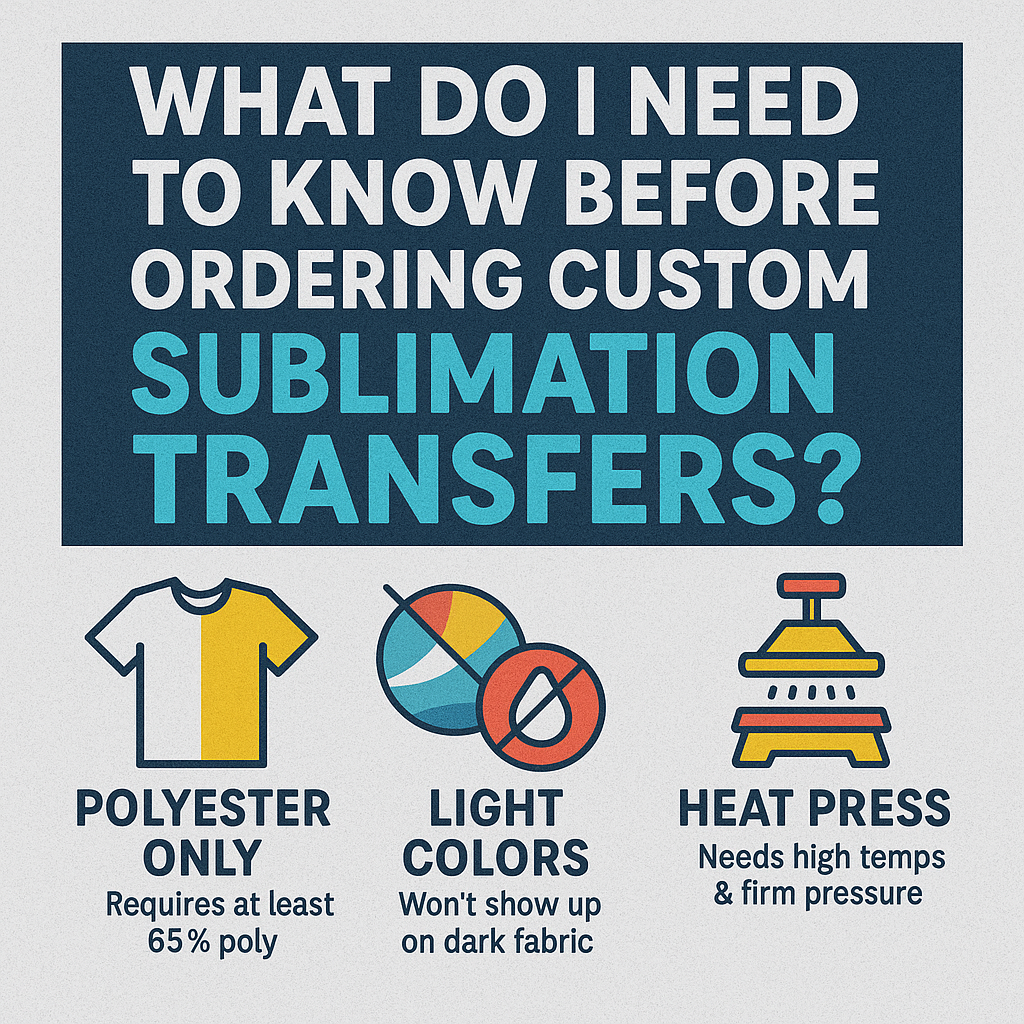
The most critical thing to know before ordering is that sublimation only works on polyester.
The Fiber Content Requirement
Because the chemical reaction requires polymer bonds, you cannot sublimate onto 100% cotton. The gas will simply pass right through the natural fibers and wash out the first time you do laundry.
- 100% Polyester: This will give you the brightest, most vibrant colors and the sharpest details.
- 65% Polyester / 35% Cotton: This is the minimum we recommend for a "vintage" or "retro" look. The ink will bond to the 65% polyester fibers but wash out of the 35% cotton fibers. This creates a faded, distressed look that is very popular, but you must expect it intentionally.
- Less than 65% Polyester: We do not recommend this. The image will look extremely faded and washed out.
The Color Requirement
Sublimation is a dyeing process. Think of it like using a marker. If you draw with a red marker on white paper, it looks red. If you draw with a red marker on black paper, you won't see it at all.
Sublimation ink is transparent. It relies on the white or light background of the shirt to show the color. You cannot sublimate on black or dark-colored fabrics.
- White fabrics: Produce the most accurate, vibrant colors.
- Light Grey or Pastels: The color of the shirt will influence the design. For example, printing a blue sky on a yellow shirt might make the sky look greenish.
- Black/Navy: Impossible with standard sublimation. For dark garments, you should use DTF transfers instead.
Artwork Requirements: No White Ink
This is the second most common stumbling block for beginners. Sublimation printers generally run CMYK (Cyan, Magenta, Yellow, Black) ink configurations. There is no white ink.
If your design has a white cloud in it, the printer simply prints nothing in that area. It assumes the shirt is white.
- If you press on a white shirt: The cloud will be white (because the shirt shows through).
- If you press on a grey shirt: The cloud will be grey.
- If you press on a pink shirt: The cloud will be pink.
If you absolutely need white ink in your design—for example, white text on a heather grey shirt—you need to switch methods. This is where DTF prints or Oracal vinyl (for hard goods) are the superior choice, as they are opaque and can print bright white on any color background.
Resolution is Key
Because sublimation dyes the fabric, it is incredibly unforgiving of low-quality art. A low-resolution image that might look okay as a distressed screen print will look blurry and pixelated as a sublimation transfer.
When uploading your art for a custom sublimation transfer, ensure your file is:
- 300 DPI (Dots Per Inch): This ensures crisp edges and clear details.
- Properly Sized: Don't upload a 2-inch logo and ask for it to be stretched to 10 inches. It will pixelate. Design your art at the actual print size.
- RGB Color Mode: While printers use CMYK, most sublimation drivers are optimized to convert bright RGB screen colors into the widest possible gamut of ink colors.
Sublimation vs. DTF vs. Vinyl: Choosing Your Fighter
Not sure if sublimation is right for you? Here is a quick breakdown of when to choose which method at Atlanta Vinyl:
- Choose Sublimation Prints if: You are printing photos, complex gradients, or multi-color designs on white 100% polyester shirts. You want a soft, breathless feel that won't crack.
- Choose DTF Transfers if: You need to print on cotton, dark fabrics, or need white ink. DTF sits on top of the fabric but works on almost any material.
- Choose Glitter DTF if: You want sparkle and texture that sublimation cannot provide.
- Choose Oracal Vinyl if: You are decorating hard surfaces like car windows or simple one-color tumblers and don't have a sublimation-coated blank.
Hard Goods: The Coating Factor
Sublimation isn't just for shirts. It is famous for mugs, tumblers, keychains, and photo slates. However, you cannot just grab a ceramic mug from the dollar store and sublimate it.
Just like with fabric, the ink needs a polymer to bond to. Hard goods must be "poly-coated" specifically for sublimation. If you try to press a transfer onto regular glass or ceramic, the ink will wipe right off. Always ensure you are buying "sublimation blanks."
The Equipment: Heat and Pressure
Finally, before ordering, check your equipment. Sublimation requires high, consistent heat—usually between 385°F and 400°F—for a longer duration (often 45-60 seconds).
A standard household iron will not work. You cannot generate enough consistent pressure or heat. You need a dedicated heat press.
- Consistency is King: Cold spots on your platen will result in "ghosting" or faded areas in your print. Investing in a quality machine like a MEM Heat Press ensures even edge-to-edge heat distribution, which is critical for full-color sublimation.
- Pressure: You typically need medium-firm pressure to push the gas into the fibers.
- Blowout Paper: Always use butcher paper or blowout paper on top of and underneath your transfer. The ink turns into a gas and can bleed through the paper onto your heat press platen. If that happens, the ink will transfer onto the next shirt you press, ruining it.
Sublimation is a powerful tool in any decorator's arsenal. It offers unmatched durability and color vibrancy for light-colored performance wear and photo gifts. By understanding the rules regarding fabric content, color, and artwork preparation, you can unlock professional results that will wow your customers.
If your project fits the criteria—polyester, light color, no white ink needed—then custom sublimation transfers are the perfect solution. If not, our DTF transfer options are ready to pick up the slack.
Ready to get started? Upload your artwork today at Atlanta Vinyl and experience the difference of high-quality, professional transfers delivered right to your door.