
Upgrading your equipment marks an exciting milestone for any custom apparel business or dedicated crafter. Moving away from a household iron or a hobby-grade hand press opens the door to professional, long-lasting results. However, shopping for a commercial heat press quickly reveals a massive variety of styles, sizes, and features. Choosing the wrong machine can lead to wasted workspace, blown budgets, or physical strain during high-volume production.
Finding the perfect heat press requires matching the machine’s capabilities to your specific goals. A shop specializing in oversized hoodies needs different equipment than a crafter making custom ceramic coffee mugs. This comprehensive guide will help you evaluate the different types of heat press machines, determine the ideal platen size, and decide which features matter most for your workflow. By the end of this post, you will know exactly what to look for when investing in your next heat press.
Evaluate Your Workspace and Budget First
Before you start looking at specific machine styles, you must assess your physical workspace and your budget. These two factors will immediately narrow down your options and prevent you from buying a machine that does not fit your operational realities.
Heat presses generate a significant amount of heat and require a sturdy, dedicated table or stand. Some machines need extra clearance above them, while others require extensive room to the sides or front. Measure your available table space and note any overhead cabinets or shelves that might interfere with the machine's movement. If you're working out of a spare room, our guide on how to set up a heat press station in a small space has layout tips.
Budget also plays a critical role. A basic manual press will cost significantly less than a fully automatic, pneumatic model. Determine your spending limit early on, but remember that a heat press is the engine of your business. Investing in a reliable, high-quality brand ensures consistent heating and prevents costly misprints that eat into your profit margins over time.
Understand the Types of Heat Press Machines
The mechanics of how a heat press opens and closes dictate how you will interact with the machine daily. There are three primary styles for flat items, plus a whole category of specialty presses for dimensional products. For a deeper comparison of the two most common styles, see our guide to swing-away vs. clamshell heat presses.
Clamshell Heat Presses
A clamshell press features a top heat platen that opens and closes on a hinge, much like an oyster shell. This is the most popular style for beginners and small businesses because of its straightforward operation.
The biggest advantage of a clamshell press is its compact footprint. Because the top platen simply lifts upward, it requires very little space around the sides or back of the machine. This makes it highly suitable for small craft rooms, spare bedrooms, or tight workshop corners. Clamshell presses also involve fewer moving parts, which often translates to a lower price point and high durability.
The main drawback involves the heat source. When a clamshell press is open, the hot upper platen remains directly over your hands while you arrange your garments. You must take extra care to avoid accidental burns. Additionally, clamshell presses are less ideal for pressing extremely thick items, like wooden plaques or thick tiles, because the hinged design can apply uneven pressure on bulky substrates.
Swing-Away Heat Presses
Swing-away presses operate by lifting the top heating platen slightly and then swinging it completely out of the way to the right or left.
This design offers an entirely heat-free workspace. When you need to load a t-shirt, place your Direct-to-Film (DTF) transfer, and smooth out wrinkles, the hot platen is safely pushed to the side. This prevents accidental burns and gives you a clear, top-down view of your project for perfect alignment. Swing-away presses also apply pressure straight down. This vertical pressure mechanism provides highly even heat and pressure distribution, making it the superior choice for thick items like mousepads, tiles, and thick sweatshirts.
The primary disadvantage is the space requirement. You must have enough clear space on your table to accommodate the full swing of the upper platen. They also require slightly more physical effort to operate, as you have to lift, swing, and then lock the platen down.
Draw Heat Presses
Draw presses blend the benefits of clamshell and swing-away models. The top heat platen remains stationary, and the lower platen pulls out toward you, operating much like a drawer in a filing cabinet.
By pulling the lower platen out, you achieve a heat-free workspace for arranging your garments and transfers. This style gives you the safety and visibility of a swing-away press without requiring the extra side clearance. It is an incredibly efficient design for high-volume shops where operators need to load and unload items rapidly.
However, because the bottom platen moves, you must ensure your transfers and garments are completely secure before pushing the drawer back under the heat source. A sudden movement can shift your design just before pressing.
Specialty Heat Presses
If your business focuses on items that are not flat, you will need a specialty press designed to accommodate curved surfaces.
- Hat Presses: These cap presses feature a curved lower platen that holds the crown of a baseball cap tight, while a curved upper platen applies the heat transfer perfectly.
- Mug and Tumbler Presses: These cylindrical presses wrap around drinkware, applying even heat and pressure required for sublimation or curing UV DTF wraps.
- Attachment Presses: Some machines, often called combo presses, allow you to swap out the flat platen for mug, hat, or plate attachments. While versatile, they can be tedious to assemble and disassemble frequently.
Picking the Right Platen Size
The platen size dictates the maximum size of the design you can press in a single motion. Choosing the right size depends entirely on the types of products you plan to create.
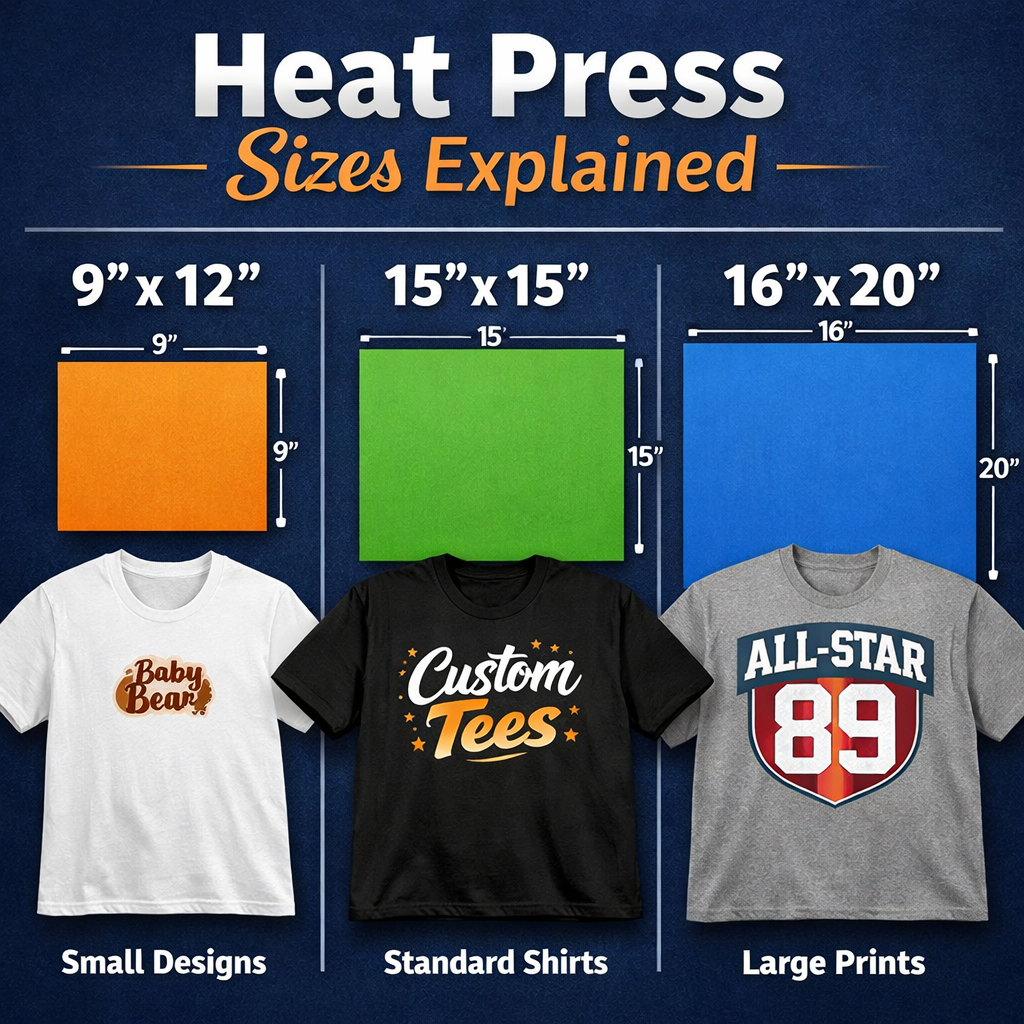
The 9" x 12" Press
This compact size is excellent for hobbyists making baby clothes, toddler t-shirts, small tote bags, and personalized patches. It heats up quickly and is highly portable. However, if you try to press a large adult t-shirt on a 9" x 12" platen, you will likely have to press the design in multiple sections, which increases the risk of uneven application and visible seams in your vinyl.
The 15" x 15" Press
This is widely considered the industry standard for small businesses and serious crafters. A 15" x 15" platen comfortably accommodates standard designs for adult apparel, ranging from size small up to extra-large. It provides an excellent balance between versatility and workspace efficiency. For the vast majority of custom t-shirt businesses, this size handles 95% of incoming orders seamlessly.
The 16" x 20" Press
If your business focuses on oversized garments, sports jerseys with large numbers, big tote bags, or all-over sublimation prints, you need a 16" x 20" press. This larger surface area saves you from the headache of double-pressing big designs. Keep in mind that these machines are significantly heavier, require more power, and demand a sturdy dedicated workbench.
Key Features to Consider
Beyond the physical style and size, modern heat presses offer specific technological features that can drastically improve your workflow and the quality of your finished products.
Manual vs. Automatic Opening
A standard manual press requires you to physically lift the handle when the timer goes off. If you get distracted by a phone call or a customer, the press stays closed, potentially scorching the fabric or melting the vinyl.
Auto-open machines feature a magnetic or pneumatic release mechanism. Once the digital timer reaches zero, the press pops open automatically. This feature is a game-changer for solo operators who need to multitask. You can start pressing a shirt, walk away to weed your next vinyl design, and trust that the machine will release exactly when it should.
Digital Time, Temperature, and Pressure Controls
In the past, heat presses relied on analog dials that offered a general estimate of the temperature. Today, precision is mandatory. Materials like custom DTF transfers, sublimation papers, and specialty HTV require highly specific heat and time settings to bond correctly.
Always look for a machine with a digital control panel. Digital temperature displays ensure your platen stays exactly at the required heat level. Digital timers prevent under-curing or over-baking your designs. The most advanced models even feature digital pressure readouts, taking the guesswork out of turning the pressure adjustment knob. When you can consistently replicate the exact time, temperature, and pressure for every single press, your rejection rate drops to zero.
Making Your Final Decision
Selecting your machine comes down to evaluating your daily production needs. If you work in a tight space and primarily make standard t-shirts, a 15" x 15" digital clamshell press will serve you perfectly. If you focus on thick items like sublimated slates or heavy hoodies, invest in a 15" x 15" or 16" x 20" swing-away press to ensure even pressure. If high-volume production and multitasking define your days, prioritize an auto-open feature to save time and prevent costly mistakes.
Do not compromise on the core functionalities that drive your business. A reliable, well-built heat press pays for itself quickly through improved product quality and efficient production.
Take the next step in elevating your custom apparel business by exploring the professional-grade equipment available at Atlanta Vinyl. From highly reliable clamshells to advanced auto-open and specialty machines, we stock the industry's most trusted brands. Browse our collection today to find the perfect heat press for your workspace, budget, and creative goals.