
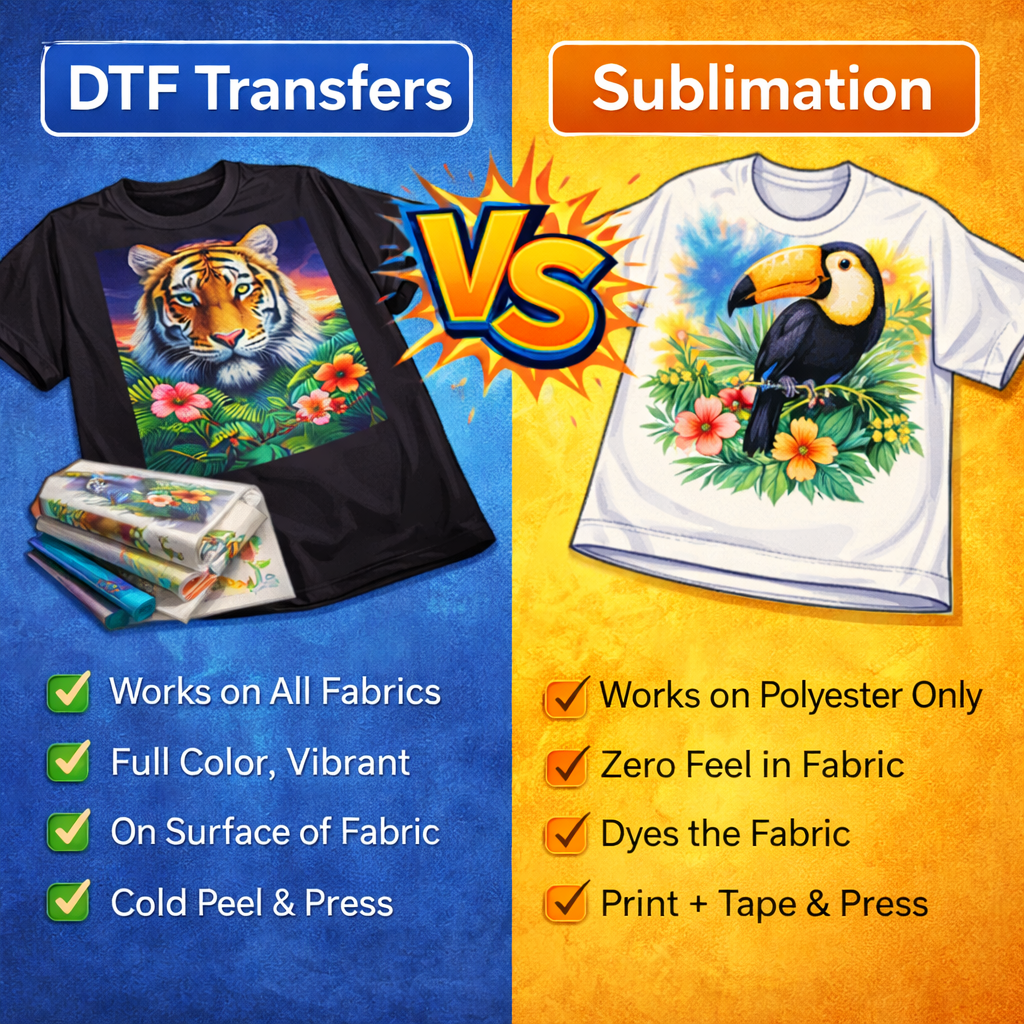
In the dynamic world of custom apparel and product decoration, two technologies stand out for their ability to produce vibrant, full-color designs: Direct-to-Film (DTF) transfers and sublimation printing. Both methods use heat to create stunning results, but they operate on entirely different principles. This leads to crucial differences in feel, durability, fabric compatibility, and overall cost.
Choosing the wrong method can result in a faded design, a stiff print, or a product that simply doesn't meet expectations. To help you make the best decision for your business or hobby, we are breaking down the matchup between DTF transfers and sublimation, head-to-head. Understanding the unique strengths and weaknesses of each will empower you to select the perfect tool for every job.
The Core Difference: Bonding vs. Dyeing
The most important thing to understand is how each process works at a molecular level.
Sublimation is a dyeing process. It uses special ink that, when heated, turns from a solid into a gas and permanently embeds itself into the fibers of polyester material. The ink becomes part of the fabric. This is why you cannot feel a sublimation print at all—it has zero texture or "hand."
DTF (Direct-to-Film) is a transfer process. An image is printed onto a special film, and a powdered adhesive is applied to the ink. When you heat press the DTF transfer, the adhesive melts and bonds the ink on top of the fabric. While modern DTF is very thin and flexible, it still creates a distinct layer on the garment's surface.
This fundamental difference—dyeing the fabric vs. bonding to the surface—is the source of all their respective pros and cons.
Round 1: Fabric Compatibility
This is the most significant deciding factor between the two methods and the first question you should ask.
Sublimation: The Polyester Specialist
Sublimation only works on polyester. The chemical process of the ink turning to gas and bonding with fibers is exclusive to synthetic polymer materials. It requires a high polyester count (ideally 100%, but no less than 65%) to produce a vibrant, permanent image. On cotton, the ink has nothing to bond with and will wash out almost immediately.
Furthermore, because sublimation is a dyeing process, it has no white ink. This means it can only be used on white or very light-colored garments. If you sublimate a yellow design onto a light blue shirt, the colors will mix and the design will appear green. It is invisible on black or dark-colored fabrics.
- Works On: High-polyester count, light-colored fabrics.
- Does Not Work On: Cotton, dark fabrics.
DTF Transfers: The Universal Solution
This is where DTF has a massive advantage. The adhesive on DTF transfers is formulated to stick to a huge variety of materials. It creates a strong mechanical bond regardless of the fiber content.
DTF works on:
- 100% Cotton
- 100% Polyester
- Poly/Cotton Blends
- Tri-Blends
- Nylon
- Canvas
- Denim
- Even hard surfaces like wood or leather
DTF technology also includes white ink, which is printed as an underbase behind the colors. This means you can press a full-color, vibrant design onto a black, navy, red, or any other colored garment with perfect opacity.
Winner: DTF Transfers. Its ability to work on any fabric of any color makes it infinitely more versatile.
Round 2: Feel and Texture (The "Hand")
How a design feels on a shirt is critical to the wearer's experience.
Sublimation: Absolutely Zero Hand
Because the ink becomes one with the fabric, a sublimated design has no feel whatsoever. You can run your hand over it, stretch it, and it feels exactly like the rest of the shirt. This makes it the undisputed champion for performance wear, athletic jerseys, and any application where a completely breathable, weightless print is desired.
DTF Transfers: A Soft, Flexible Layer
A DTF print sits on top of the fabric. While high-quality modern transfers are incredibly thin, soft, and flexible, they are not zero-hand. You can feel the design on the shirt. For very large, solid designs, this can impact breathability, creating a slightly more "sweaty" spot compared to the unprinted fabric. However, for most logos and graphics, the feel is very soft and is often preferred over the thick, heavy feel of layered heat transfer vinyl (HTV).
Winner: Sublimation. For a truly undetectable feel, nothing beats sublimation.
Round 3: Durability and Vibrancy
Both methods produce beautiful, professional-looking results, but they excel in different ways.
Sublimation: Unbeatable Permanence, Limited Vibrancy on Blends
A sublimated design is permanent. It will never crack, peel, or fade. The design will last as long as the garment itself. You can bleach it, and the fabric will lose color before the print does. However, the vibrancy is directly tied to the polyester count. A design on 100% polyester will be incredibly vivid. The same design on a 65% polyester blend will have a more faded, "vintage" look, as the ink has less material to bond with.
DTF Transfers: Excellent Durability, Consistent Vibrancy
A properly applied DTF transfer offers fantastic durability, often lasting 50-100 washes before showing any signs of wear. The ink bonds strongly to the surface, stretching with the fabric to resist cracking. While not technically as "permanent" as sublimation, its real-world lifespan is more than enough for commercial apparel.
The key advantage for DTF is consistency. The vibrancy of the print will be the same whether you press it on 100% cotton, a 50/50 blend, or 100% polyester. You get a bold, opaque print every single time.
Winner: It's a Tie. Sublimation wins on absolute permanence, but DTF wins on consistent vibrancy across all fabric types. For most practical purposes, both are considered highly durable.
Round 4: Upfront Cost and Ease of Use
For a business or hobbyist just starting out, the initial investment and learning curve matter.
Sublimation: Lower Entry Cost
You can get started with sublimation for a relatively low cost. The process typically involves a dedicated sublimation printer (like a converted Epson EcoTank), sublimation paper, ink, and a heat press. The process is straightforward: print, tape to the garment, and press.
DTF Transfers: Higher Equipment Cost, Simpler Workflow
Buying a professional DTF printer is a significant investment, often running into many thousands ofdollars. These printers also require regular, diligent maintenance to prevent the white ink from clogging.
However, you don't need to own a printer to use DTF. The most popular and cost-effective method is to order ready-to-press DTF transfers from a supplier like Atlanta Vinyl. This completely eliminates the equipment and maintenance costs, requiring only a heat press. The workflow is simple: position the transfer and press. There is no taping or mirroring your design.
Winner: It depends. For a DIY setup, sublimation has a lower entry cost. But for a business wanting to avoid equipment headaches, ordering DTF transfers is the simplest and most scalable path.
There is no single winner. The best method is the one that fits your specific project needs.
You should choose Sublimation if:
- You are printing exclusively on white or light-colored polyester garments.
- The primary goal is an absolutely zero-feel, breathable print (e.g., for performance jerseys or all-over prints).
- You want to create hard-surface goods like mugs, tumblers, or coasters with a glossy, permanent finish.
- You desire a slightly faded, "vintage" look on poly-blend shirts.
You should choose DTF Transfers if:
- You need to print on a variety of fabrics, especially cotton and cotton blends.
- You need to print on dark-colored garments of any kind.
- Your designs are for a retail brand and must have consistent, vibrant color across different shirt types.
- You want to run a high-volume apparel business and value a simple, fast "press-and-peel" workflow without weeding.
- You want to avoid the high cost and maintenance of owning a printer by ordering transfers on demand.
Ultimately, many successful shops use both technologies. They use sublimation for their polyester athletic orders and DTF transfers for everything else. By understanding the distinct advantages of each, you can equip your business with the right tools to tackle any customer request with confidence.