
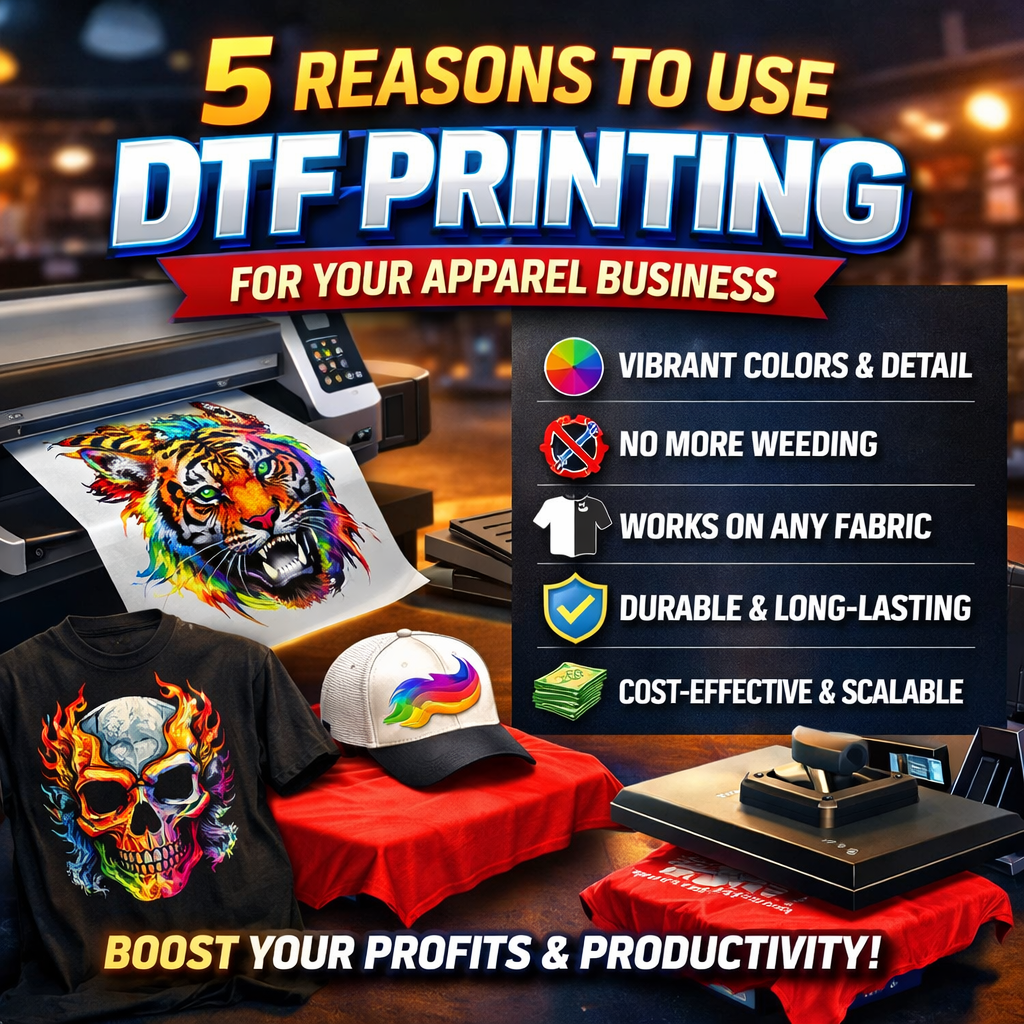
In the competitive world of custom apparel, efficiency and quality are everything. Whether you are running a boutique brand out of your garage or managing a high-volume print shop, the tools you choose dictate your success. For decades, the industry relied heavily on screen printing and standard heat transfer vinyl (HTV). While these methods have their place, a new player has changed the game completely: Direct-to-Film (DTF) printing.
If you haven't yet explored the power of custom DTF transfers, you might be leaving money on the table. This technology isn't just a trend; it's a solution to some of the biggest headaches apparel decorators face daily. From limitless color options to incredible versatility across fabrics, here are five compelling reasons why you should integrate DTF printing into your custom apparel business today.
Unleash Unlimited Color and Detail Without the Headache
For years, simplicity was the safe route. If a customer wanted a design with ten colors, intricate gradients, or a photograph, you had to say "no" or charge a fortune to cover the setup costs of screen printing or the labor of layering vinyl.
Direct-to-Film printing shatters these limitations.
No More Color Counting
With traditional screen printing, every color in a design requires a separate screen, setup time, and cleanup. This makes small runs of colorful designs prohibitively expensive. With custom DTF transfers by size, color count is irrelevant. The printer uses CMYK + White inks to reproduce millions of colors in a single pass. Whether your design has one color or one hundred, the print process—and the cost—remains largely the same.
Fine Details and Gradients
Have you ever tried to weed tiny text or distress lines out of vinyl? It is a nightmare that eats up valuable production time. DTF technology prints these fine details with razor-sharp precision. It handles fades, shadows, and photorealistic images effortlessly, allowing you to offer premium, retail-quality designs that stand out in a crowded market. You can finally say "yes" to those complex corporate logos and detailed artistic prints.
Say Goodbye to Weeding (and Save Hours of Labor)
Time is your most valuable asset. In a small business, every minute you spend prepping materials is a minute you aren't selling or growing. The single biggest bottleneck for many vinyl decorators is weeding—the tedious process of picking away excess material from a cut design.
The "Weed-Free" Workflow
DTF is entirely weed-free. The printer prints the ink onto a film, and a specialized powder adhesive bonds only to the wet ink. When you cure it, you are left with a transfer that is ready to press immediately. There is no picking, no hooks, and no waste.
Massive Labor Savings
Consider an order for 50 shirts with a moderately complex logo.
- With HTV: You might spend 5-10 minutes weeding each logo. That is over 8 hours of labor just for prep work.
- With DTF: You simply take the 50 ready-to-press transfers and start heat pressing. You have saved an entire workday of labor.
By eliminating weeding, you dramatically increase your daily throughput. You can produce more shirts in less time, which directly increases your hourly profit rate. This efficiency alone is often enough reason for businesses to make the switch.
Unmatched Versatility Across Fabrics
One of the most frustrating aspects of garment decoration is matching the right ink or vinyl to the right fabric. Screen printing water-based inks on polyester can be tricky. Sublimation only works on light-colored, high-polyester fabrics. HTV can struggle on certain textures.
DTF is the "universal donor" of the printing world. It plays nicely with almost everything.
Cotton, Polyester, and Everything in Between
The unique adhesive used in DTF transfers creates a strong mechanical bond with a wide variety of fibers. It works beautifully on:
- 100% Cotton: Achieving a soft, durable print.
- 100% Polyester: Without the rigorous pretreatment required for DTG (Direct-to-Garment).
- 50/50 Blends: The standard industry t-shirt fabric.
- Nylon and Treated Fabrics: Materials that are notoriously difficult for other methods often accept DTF well.
Dark Garments? No Problem.
Sublimation is fantastic, but it is invisible on black shirts. DTF prints a layer of white ink behind the colored pixels. This "underbase" ensures that your colors pop vibrantly, even on black, navy, or red fabrics. You don't need to keep different types of transfers for light and dark garments; one DTF transfer works on any color shirt in your inventory.
Durability That Builds Customer Trust
A pretty shirt is worthless if the design cracks or peels after two washes. Your reputation depends on the longevity of your product. Early digital transfer technologies had a bad reputation for feeling like "plastic patches" that washed poorly. DTF has completely solved these issues.
Stretch and Rebound
Modern DTF ink and adhesive are formulated to be flexible. The design stretches with the fabric and rebounds back to its original shape without cracking. This makes it an excellent choice for athletic wear and fitted garments where the fabric sees a lot of movement.
Washability
When applied correctly with a heat press, the adhesive melts into the fibers of the shirt, creating a permanent bond. Industry tests often show that DTF prints can withstand 50+ wash cycles without significant fading or peeling. This durability rivals traditional screen printing and far exceeds the lifespan of older inkjet transfer papers. When you sell a DTF-printed garment, you can be confident that your customer will be wearing it for years.
A Cost-Effective Solution for Scalability
Finally, let's talk about the bottom line. Profit margins matter. DTF offers a unique economic advantage that bridges the gap between small custom orders and large production runs.
Low Barrier to Entry
Unlike setting up a screen printing shop, which requires a darkroom, exposure units, wash-out booths, and a carousel press, using DTF transfers requires only a heat press. You don't even need to buy the expensive DTF printer yourself. By partnering with a reliable supplier like Atlanta Vinyl, you can order custom DTF gang sheets on demand.
Consistency at Any Volume
Whether you need one shirt or 500, the cost per print remains reasonable.
- For small orders: You avoid the high setup fees of screen printing.
- For large orders: You benefit from the speed of application.
This scalability allows you to grow your business without massive capital investment. You can test new designs without committing to inventory. You can offer "print on demand" services with zero risk. As your volume grows, the cost-effectiveness of DTF only improves, keeping your margins healthy.
The custom apparel industry is evolving, and Direct-to-Film printing is leading the charge. It solves the problems of color limitations, labor-intensive weeding, and fabric restrictions, all while delivering a durable, high-quality product.
By adopting DTF, you aren't just changing how you print; you are upgrading your entire business model. You are freeing up time, expanding your product offerings, and delivering better results to your customers.
Ready to experience the difference? Explore our same-day DTF rush printing service at Atlanta Vinyl and take your apparel business to the next level today.