
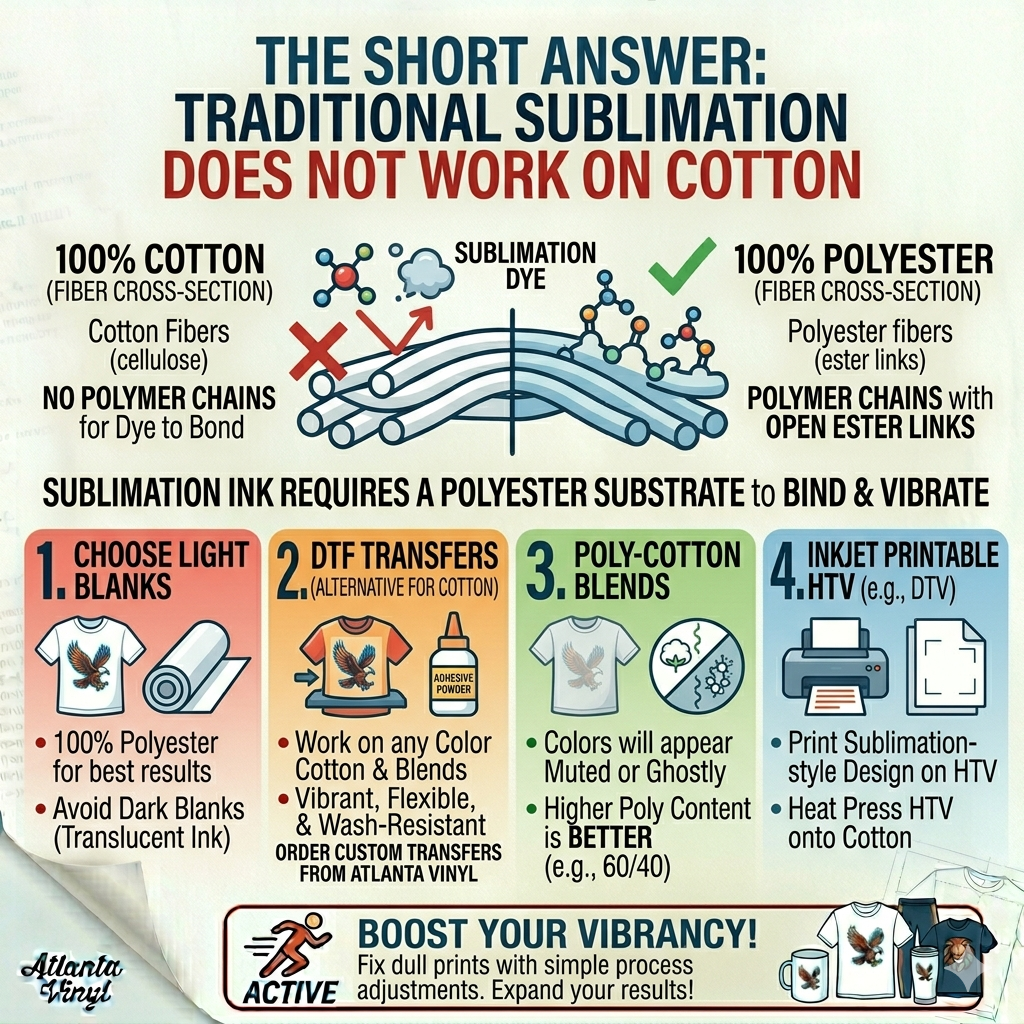
The Short Answer: Traditional Sublimation Does Not Work on Cotton
Sublimation is a chemical process that requires a polyester substrate (or a polyester-coated surface) to work properly. The sublimation dye transforms from solid to gas under heat and bonds permanently with polyester polymer chains. Cotton fibers do not have these polymer chains, which means standard sublimation ink will not bond with cotton — the dye will either wash out completely or produce extremely faded, ghostly results even if it initially appears to transfer.
This is one of the most important things beginners need to understand about sublimation. You can have perfect settings, great ink, and high-quality transfers — but if you press them onto a 100% cotton shirt, the results will be disappointing.
Why Cotton Is Incompatible with Standard Sublimation
At the molecular level, polyester contains ester linkages that open up when heated to sublimation temperatures, allowing dye molecules to enter and then lock in place as the fabric cools. Cotton lacks these linkages. Cotton is a natural fiber composed of cellulose, which doesn't open up the same way. The sublimation dye has nowhere to bond, so it sits on the surface and washes away with the first laundering.
So Can You Get Full-Color Prints on Cotton Shirts?
Absolutely — but not through traditional sublimation. Here are your best options for cotton fabrics:
Option 1: DTF (Direct-to-Film) Transfers
DTF transfers are the number one alternative to sublimation for cotton garments. They use a white ink underbase and hot melt adhesive powder to bond permanently to any fabric, including 100% cotton. The results are vibrant, flexible, and wash-resistant — and you can use them on dark cotton shirts too. For most custom apparel businesses, DTF is a superior choice to sublimation for cotton because it's more versatile and requires no special fabric requirements.
Option 2: Sublimation on Polyester-Coated Cotton
Some specialty products exist that are described as "sublimation-ready cotton" — these items typically have a thin polyester coating applied to the surface that allows sublimation ink to bond. However, the polyester coating creates a plastic-feeling surface that can crack over time, and results are generally not as vibrant or durable as sublimation on standard 100% polyester items. This approach is niche and not widely recommended for apparel.
Option 3: Inkjet Printable Heat Transfer Vinyl
Products like Siser EasyColor DTV allow you to print sublimation-style full-color designs using a standard inkjet printer onto a specially coated HTV film, which is then heat pressed onto cotton garments. The results are a step down from traditional sublimation on polyester but significantly better than trying to sublimate directly on cotton.
Option 4: Sublimation on Poly-Cotton Blends
Poly-cotton blends (such as 50/50 or 60/40 poly-cotton shirts) can accept sublimation, but the colors will appear lighter and less vibrant than on 100% polyester. The higher the polyester content, the more vibrant the results. Blends below 50% polyester will produce noticeably muted results that may not meet customer expectations.
The Best Solution for Cotton Shirts
If you want vivid, full-color, wash-resistant prints on cotton shirts, use DTF transfers. DTF is the industry's answer to cotton customization — it works on any color cotton fabric, produces professional results, and doesn't require any special shirt preparation. Atlanta Vinyl's custom DTF transfers are designed for exactly this purpose.
You cannot successfully sublimate on pure cotton. But with DTF transfers, you don't have to. Whether your customers prefer cotton, polyester, or a blend, DTF gives you a versatile solution that delivers excellent results across all fabric types. Order your custom DTF transfers from Atlanta Vinyl and expand your cotton shirt offerings with confidence.