
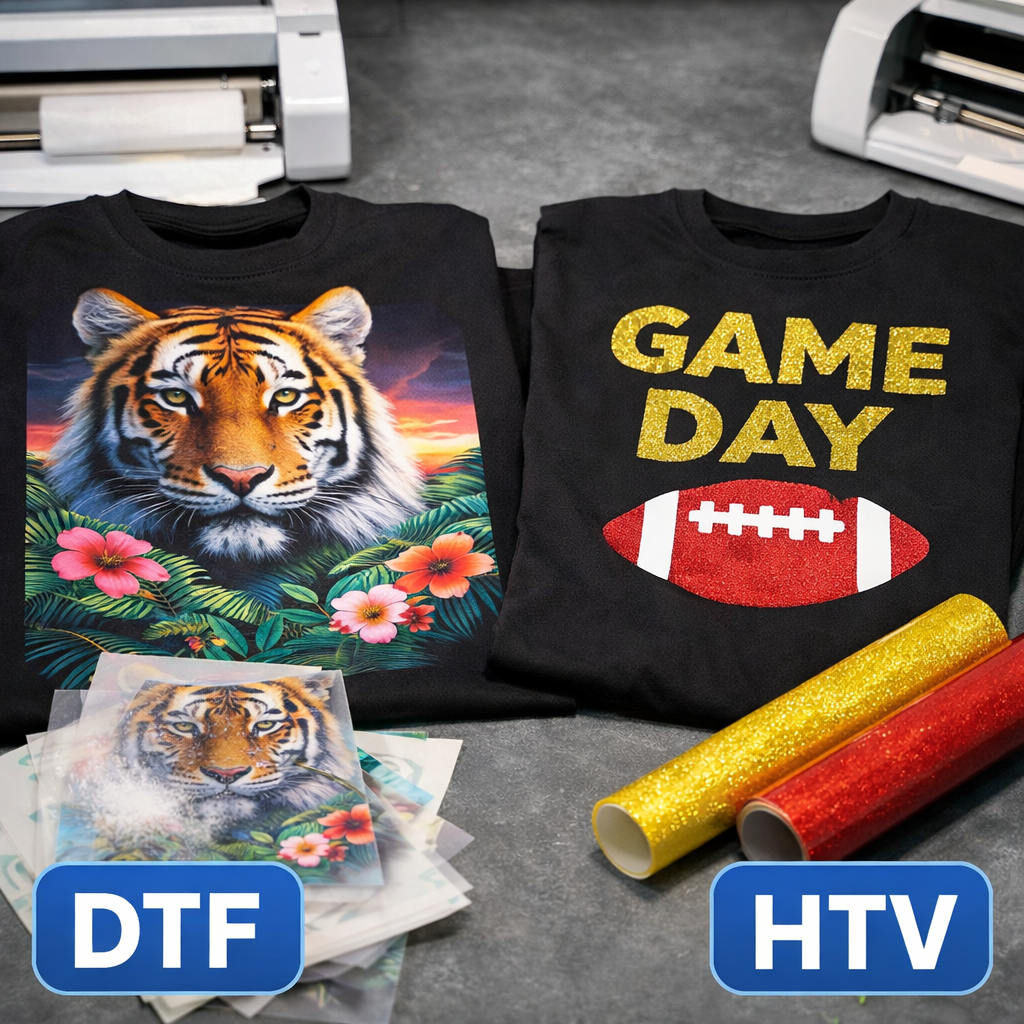
If you are stepping into the world of custom apparel, you have likely encountered two very popular acronyms: DTF and HTV. Both methods allow you to put beautiful designs on fabrics, but they do it in very different ways. Choosing between Direct-to-Film (DTF) printing and Heat Transfer Vinyl (HTV) can feel overwhelming, especially when you are trying to balance cost, quality, and time.
Whether you are a hobbyist making shirts for a family vacation or a business owner fulfilling hundreds of orders, understanding the strengths and weaknesses of each method is crucial. In this guide, we will compare DTF printing and HTV vinyl head-to-head so you can decide which one wins a spot in your workflow.
What is HTV (Heat Transfer Vinyl)?
Heat Transfer Vinyl, or HTV, is a polyurethane material with a heat-activated adhesive backing. It comes in rolls or sheets of solid colors, patterns, and special finishes like glitter or puff vinyl.
To use HTV, you load the material into a vinyl cutter (like a Cricut or Silhouette), cut out your design, "weed" away the excess material, and then heat press it onto your garment.
The Pros of HTV
- Specialty Finishes: This is where HTV truly shines. You can achieve looks that are impossible with ink, such as metallic foil, holographic shine, fuzzy flock, or 3D puff.
- Low Barrier to Entry: You don't need expensive industrial printers. A simple craft cutter and a heat press are all you need to get started.
- Durability: High-quality Heat Transfer Vinyl (HTV) is incredibly durable. When applied correctly, it won't crack or fade easily and can outlast the garment itself.
- No Ink Mess: Since you are working with solid materials, there are no liquid inks, clogging print heads, or messy maintenance routines.
The Cons of HTV
- Weeding Time: This is the biggest drawback. For every shirt, you must manually remove the excess vinyl. If you have a complex design with intricate details, this can take 10-20 minutes per shirt.
- Color Limitations: Standard HTV is generally one color per layer. If you want a 5-color design, you have to cut, weed, and press five different layers. This makes photorealistic images or gradients nearly impossible.
- Feel (Hand): Multiple layers of vinyl can feel heavy and thick on a shirt, sometimes creating a "sweat patch" effect.
What is DTF (Direct-to-Film) Printing?
Direct-to-Film printing is a newer technology that has rapidly gained popularity. It involves printing a design onto a special PET film using water-based inks. A powdered adhesive is applied to the wet ink, cured with heat, and the resulting transfer can be heat pressed onto almost any fabric.
You can buy your own printer, but many businesses prefer to buy ready-to-press DTF Transfers from a provider like Atlanta Vinyl to save on equipment costs.
The Pros of DTF
- Full-Color Detail: DTF prints in CMYK + White, meaning you can print photographs, gradients, and unlimited colors in a single pass. There is no layering required.
- No Weeding: This is a game-changer. The printer prints exactly what you need. There is no excess material to pick away. You simply print (or buy), press, and peel.
- Versatility: DTF plays nicely with almost everything—cotton, polyester, 50/50 blends, nylon, and even treated fabrics that HTV might struggle to adhere to.
- Soft Hand Feel: While not as soft as sublimation, modern DTF transfers are significantly thinner and softer than layered HTV.
The Cons of DTF
- Equipment Cost: A reliable commercial DTF printer setup is expensive and requires significant maintenance to prevent the white ink from clogging. This is why many shops outsource the printing.
- Breathability: DTF creates a solid layer of ink and adhesive. On large solid designs, it can feel a bit like a plastic patch that doesn't breathe well.
Head-to-Head Comparison
Let's break down how these two contenders stack up in specific scenarios.
Complex Multi-Color Designs
Winner: DTF
If your customer wants a logo with seven colors, gradients, and tiny text, HTV is a nightmare. You would spend hours layering vinyl. With DTF Transfers, that complex design prints in seconds and presses in one step.
Simple, Bold Text and Numbers
Winner: HTV
For sports jerseys with names and numbers, or simple slogans like "Bride Tribe," HTV is often faster and more cost-effective. You can cut a name in seconds, weed it quickly, and press it. Plus, the solid colors of HTV are incredibly vibrant and crisp.
Special Effects
Winner: HTV
DTF is essentially flat ink. If you want texture or shine, you need vinyl. If you want a design to puff up, reflect light, or sparkle like glitter, you need specialty HTV Vinyl. While some "glitter DTF" films exist, they rarely match the intensity of actual glitter vinyl.
Small Batches vs. Large Orders
- Small Batches (1-10 shirts): Both work well. HTV is great for on-demand one-offs.
- Large Orders (50+ shirts): DTF wins hands down on labor. Imagine weeding 50 complex designs versus just pressing 50 ready-made transfers. The labor savings with DTF are massive.
Which One Should You Choose?
The answer, as always, is: It depends on what you are making.
Choose HTV Vinyl if:
- You are doing simple, 1-3 color designs.
- You need specialty finishes like glitter, metallic, or puff.
- You are making sports jerseys or simple text-based apparel.
- You enjoy the crafting process and already own a cutter.
Choose DTF Printing (or Transfers) if:
- Your designs have many colors, gradients, or fine details.
- You need to print photographs.
- You are fulfilling a large order and need to save time on labor.
- You want to print on difficult fabrics like nylon or polyester without dye migration issues.
The Hybrid Approach
The best part? You don't actually have to choose just one. Most successful apparel businesses use both methods.
You might use HTV for a custom golden birthday shirt and DTF for a local company's colorful logo on 50 hoodies. At Atlanta Vinyl, we supply both high-quality Heat Transfer Vinyl and custom DTF Transfers, so you have the right tool for every job.
By understanding the strengths of each method, you can optimize your workflow, increase your profit margins, and deliver the best possible product to your customers.